
Introduction
Ask a hospital COO what’s slowing their organization down, and the answer is rarely clinical. Surgeons are not operating more slowly. Nurses are not less capable. The delays come from everything wrapped around the care. An authorization must clear before a scan is booked. A claim comes back over a missing field. A discharge waits four hours on transport. A note gets finished at 9 p.m. at the kitchen table.
These are administrative problems, not medical ones. They are also expensive. The American Hospital Association’s Costs of Caring 2026 report estimates hospitals spent $43 billion in 2025 trying to collect payments insurers already owed them for care delivered.
The pressure is not easing. CMS actuaries, writing in Health Affairs, project national health spending will reach nearly $9.0 trillion by 2034, or 20.6% of the economy.
The AAMC projects a shortage of up to 86,000 physicians by 2036, and the WHO estimates a global shortfall of 11 million health workers by 2030. More patients, fewer clinicians. Removing administrative friction is one of the few levers left.
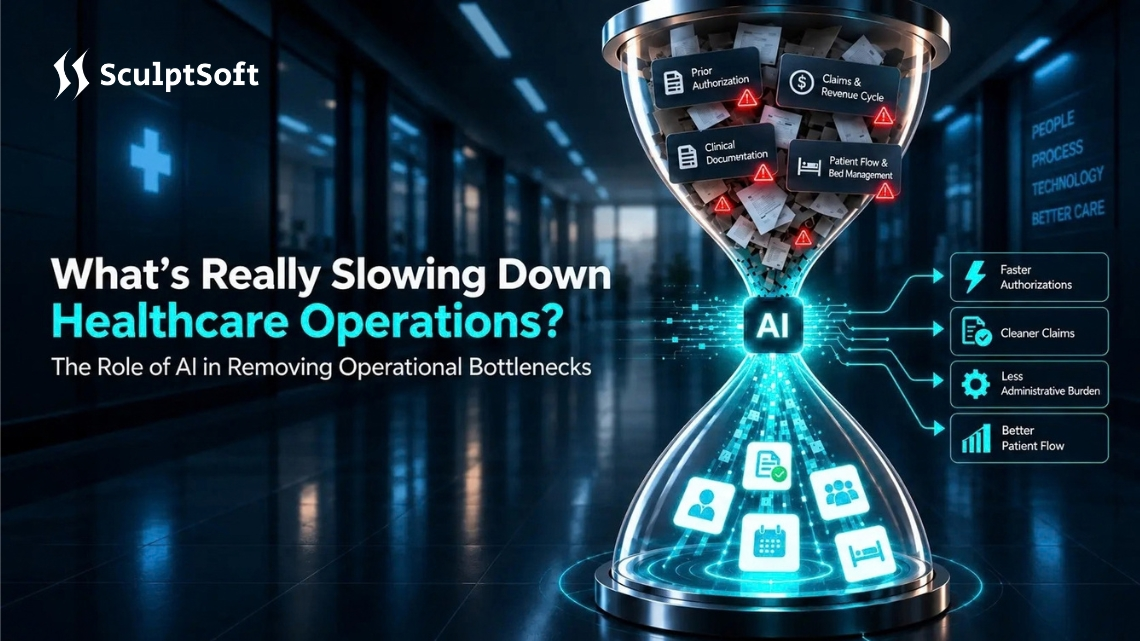
AI can help address these bottlenecks by reducing the manual work that slows processes down. Instead of treating AI as a tool only for diagnosis or clinical decision-making, healthcare organizations can use it to automate repetitive administrative tasks, route information between systems, identify missing data, summarize documentation, support scheduling and authorization workflows, and surface exceptions that require human attention.
The goal is not to replace clinicians or operational teams. It is to remove avoidable friction so people can spend more time on work that requires judgment, coordination, and patient interaction.
The Cost of Administrative Friction, in Numbers
Before looking at solutions, it helps to see the scale in one place.
| Where time and money go | What the data shows | Source |
|---|---|---|
| Prior authorization workload | 40 requests per physician per week, absorbing 13 hours of physician and staff time | 2025 AMA Prior Authorization Physician Survey (published 2026) |
| Prior authorization volume | Nearly 53 million determinations by Medicare Advantage insurers in 2024 | KFF (2026) |
| Claim denials | Initial denial rate of 11.81% in 2024, up from 10.2% in 2020 | Kodiak Solutions (2025) |
| Chasing payment | $43 billion spent in 2025, including nearly $18 billion on overturning denials | AHA Costs of Caring (2026) |
| Administrative staffing | About 64 administrative and billing staff per hospital in 2024, roughly 6.5% of hospital employment | AHA Costs of Caring (2026) |
| Industry-wide transactions | Roughly $83 billion a year in staff time, with providers absorbing 97% of the cost | CAQH |
Where time and money go
Prior authorization workload
What the data shows
40 requests per physician per week, absorbing 13 hours of physician and staff time
Source
2025 AMA Prior Authorization Physician Survey (published 2026)
Where time and money go
Prior authorization volume
What the data shows
Nearly 53 million determinations by Medicare Advantage insurers in 2024
Source
KFF (2026)
Where time and money go
Claim denials
What the data shows
Initial denial rate of 11.81% in 2024, up from 10.2% in 2020
Source
Kodiak Solutions (2025)
Where time and money go
Chasing payment
What the data shows
$43 billion spent in 2025, including nearly $18 billion on overturning denials
Source
AHA Costs of Caring (2026)
Where time and money go
Administrative staffing
What the data shows
About 64 administrative and billing staff per hospital in 2024, roughly 6.5% of hospital employment
Source
AHA Costs of Caring (2026)
Where time and money go
Industry-wide transactions
What the data shows
Roughly $83 billion a year in staff time, with providers absorbing 97% of the cost
Source
CAQH
Where Does the Time Actually Go?
Four areas account for most of the delay: prior authorization, revenue cycle, clinical documentation, and bed management.
Why Does Prior Authorization Consume So Much Clinical Time?
Prior authorization is the clearest example of a process that uses clinical time without improving clinical care. The 2025 AMA Prior Authorization Physician Survey, which polled 1,000 practicing physicians in December 2025, found that each physician completes about 40 authorization requests a week. Those requests absorb 13 hours of physician and staff time. Two in five physicians (40%) said they employ staff working exclusively on prior authorization.
The volume is not an outlier. KFF found that Medicare Advantage insurers made nearly 53 million prior authorization determinations in 2024, up from roughly 50 million the year before.
The effects reach the bedside. In the same survey, 95% of physicians said prior authorization delays access to necessary care, and 26% said it had contributed to a serious adverse event. AMA President Bobby Mukkamala, M.D., said physician trust in voluntary insurer pledges is “deeply eroded after years of unfulfilled promises.”
Much of this work is structured enough to automate. The requests follow templates, and the clinical criteria are already in the record. The bottleneck is retrieval and assembly, not clinical judgment. That is why authorization sits near the top of most EHR integration roadmaps for AI agents.
Why Has Getting Paid Become Its Own Department?
When a claim is denied, the work starts over. Someone has to review it, gather documentation, resubmit, and follow up. Kodiak Solutions, using data from more than 2,100 hospitals and 300,000 physicians, reported that the initial denial rate rose to 11.81% of claims in 2024, up from 11.5% in 2023 and 10.2% in 2020.
The reasons for denial are shifting. Denials tied to authorization actually fell 7.7%, while denials questioning medical necessity rose 5% and requests for additional information rose 5.4%. Payers have moved from challenging whether care was approved to challenging whether it was documented.
Even claims that are eventually paid carry a cost. Matt Szaflarski, Kodiak’s vice president of revenue cycle intelligence, noted they still take “a lot of resources to overturn.” Industry-wide, CAQH estimates that routine transactions between providers and health plans consume about $83 billion a year in staff time. Providers absorb 97% of that.
What Happens When the Note Follows Clinicians Home?
Documentation burden becomes a staffing problem over time. Clinicians who spend their evenings closing charts tend to leave sooner, and every departure means months of recruiting and lost productivity.
The effect is measurable. In 2025, JAMA Network Open published an analysis of UChicago Medicine’s ambient documentation pilot comparing AI scribe users against a matched group of non-users. Scribe users spent more than 15% less time composing notes and 8.5% less total time in the electronic health record. Two or three minutes saved per patient sounds small until you multiply it across a clinic day.
If Beds Aren't the Bottleneck, What Is?
Most hospitals are not short on beds so much as blind to them. Discharge orders, transport, housekeeping, and bed assignment sit in separate systems that do not update each other in real time. A patient who is medically ready at 10 a.m. often leaves at 4 p.m. Those six hours are not clinical care. They are a coordination failure, and the delay spreads into emergency department crowding, ambulance diversion, and a canceled elective case the next morning.
The same blindness appears at the front door. One US healthcare provider had a single on-call nurse fielding every after-hours call, with no way to separate a refill question from an emergency. The AI-powered call center system we built used a custom-trained GPT-4 model with Twilio to handle routine inquiries and appointment booking around the clock, escalating urgent calls to a clinician. The nurse was no longer the bottleneck.
How One Hospital Found Its Delays Before Patients Complained
Knowing a queue exists is different from knowing where inside it the time is lost. A US hospital running an AI-assisted call and portal system could see patients were waiting, but not at which step. Azure Application Insights was already collecting the telemetry. Nobody could turn it into an answer, so problems surfaced only when someone complained.
We built TimeGap Monitor to close that gap. Kusto Query Language scripts measured the delay between consecutive events, Power Query structured the output, and Power BI dashboards showed where journeys stalled. The hospital reported 65% better end-to-end visibility and 50% faster bottleneck detection. This measurement step is the one most AI programs skip. You cannot shorten a queue you cannot see.
Once delays are visible at the event level, teams can distinguish between isolated slowdowns and recurring workflow bottlenecks. This makes it easier to identify whether delays originate from system response times, handoffs, missing information, or process dependencies.
That visibility also creates a measurable baseline for improvement. Instead of relying on complaints or anecdotal feedback, operations teams can compare bottleneck duration before and after workflow changes and determine whether an intervention actually improves the patient journey.
What Does the Evidence Say AI Can Actually Fix?
The strongest published results so far come from ambient documentation and patient flow.
| Application | Documented result | Source |
|---|---|---|
| Ambient AI scribes | Burnout among ambulatory clinicians fell from 51.9% to 38.8% after 30 days (263 clinicians, six health systems) | JAMA Network Open, reported by the AMA |
| Ambient documentation | Burnout at Mass General Brigham fell from 52.6% to 30.7% at 84 days, a 21.2% absolute reduction | Mass General Brigham |
| AI scribe efficiency | More than 15% less time composing notes versus matched non-users | UChicago Medicine |
| Patient flow command center | Emergency department arrival-to-departure time down 8%; days above geometric mean length of stay down 27% | AHA, on Sutter Health’s 2025 pilot |
Application
Ambient AI scribes
Documented result
Burnout among ambulatory clinicians fell from 51.9% to 38.8% after 30 days (263 clinicians, six health systems)
Source
JAMA Network Open, reported by the AMA
Application
Ambient documentation
Documented result
Burnout at Mass General Brigham fell from 52.6% to 30.7% at 84 days, a 21.2% absolute reduction
Source
Mass General Brigham
Application
AI scribe efficiency
Documented result
More than 15% less time composing notes versus matched non-users
Source
UChicago Medicine
Application
Patient flow command center
Documented result
Emergency department arrival-to-departure time down 8%; days above geometric mean length of stay down 27%
Source
AHA, on Sutter Health’s 2025 pilot
The documentation findings come from two independent studies: a JAMA Network Open quality improvement study reported by the AMA, and a Mass General Brigham–led survey of more than 1,400 clinicians at Mass General Brigham and Emory Healthcare. Rebecca Mishuris, M.D., the health system’s chief medical information officer, called the technology “truly transformative in freeing up physicians from their keyboards.”
The patient flow figures come from the AHA’s account of Sutter Health’s command center pilot across three hospitals in 2025. The AHA described that 27% reduction as roughly equivalent to adding 12 beds a day.
The pattern is consistent. AI performs well on bottlenecks that are predictable, repetitive, and rich in data. It does nothing for broken contracts, unclear ownership, or a process nobody has mapped.
Why Do So Many AI Deployments Stall?
Adoption is uneven, and it is worth being honest about why. In a 2026 revenue cycle survey reported by Healthcare Finance News, 59% of respondents had not yet implemented AI or automation in the revenue cycle. Only 2% described it as fully or mostly integrated. The obstacle is rarely the model. It is data readiness, integration depth, and change management – the same pattern behind why most AI projects fail in any industry.
Another reason deployments stall is that AI often gets introduced as a standalone capability rather than as part of an existing operational workflow. A model may summarize clinical notes or predict claim issues accurately, but the value remains limited if its output cannot flow into the EHR, revenue cycle platform, payer workflow, or clinician review process. Successful deployment therefore requires connecting AI outputs to the systems and decisions where they can produce measurable operational impact.
Organizations also need clear controls around how AI-generated outputs are reviewed, monitored, and used. Healthcare workflows involve sensitive data, regulated processes, and decisions that can affect patients and reimbursement. Without defined ownership, auditability, human oversight, and performance monitoring, teams may struggle to determine when an AI system should be trusted, reviewed, corrected, or taken out of the workflow.
Two cautions belong on the record:
- Automation works for both sides. Six in ten physicians in the AMA survey said they were concerned that AI could push denial rates higher on the payer side.
- A draft is not a record. Ambient documentation still requires clinician review before anything enters the chart. AI produces the draft; the clinician signs it.
How Should a Health System Sequence Its Rollout?
Sequencing matters more than ambition. Most healthcare AI programs stall because they begin in the wrong place. The four steps below keep a rollout grounded in something measurable, each depending on the one before.
- Pick a well-defined process first. Eligibility verification, coding support, and discharge prediction work well as starting points, because the inputs are structured and the result is countable.
- Measure the baseline before deploying. Without a starting number, “it feels faster” is the only result you will get.
- Fix the data layer before the model. When admission, discharge, and transfer records reside in one system and claims data in another, poorly integrated sources produce fragmented answers. This is why data engineering comes before AI and ML, and why the pipeline work often takes longer than the model itself.
- Scale into the workflow, not around it. AI and ML development that fits how clinicians already work gets adopted. Anything else gets bypassed.
Before expanding beyond the pilot, health systems should validate the system against real operational outcomes. Accuracy alone is not enough; teams should also track adoption, exception rates, processing time, and downstream impact on care and revenue.
Each deployment also needs ongoing governance rather than a one-time approval. Monitoring should identify model drift, data-quality problems, unexpected outputs, and workflow changes so teams can intervene before performance or patient safety is affected.
Regulation is moving in the same direction. CMS interoperability rules now cover Medicare Advantage, Medicaid, CHIP, and Marketplace plans on the federal exchange. Since January 2026, those payers must answer standard prior authorization requests within seven calendar days, down from 14. Standardized electronic prior authorization interfaces follow in January 2027. Organizations with clean data pipelines will absorb that change. Others will scramble.
Conclusion
The bottlenecks slowing healthcare down are administrative, and they grow more expensive every year. What the current evidence supports is narrower and more useful than the surrounding hype: ambient documentation reduces burnout, command centers recover real capacity, and predictive workflows shorten queues. All of it depends on coherent data and someone accountable for the result.
The health systems pulling ahead are not the ones with the biggest AI budgets. They are the ones that identified which queue was backing up, measured it honestly, and fixed it before moving to the next. If you are not sure which queue that is in your organization, that is the first problem to solve. Talk to our team, and we will start there.
The opportunity is not simply to add AI to existing healthcare processes. It is to redesign how work moves through those processes, using AI to connect fragmented information, automate routine steps, and bring exceptions to the right person at the right time. When implemented this way, AI becomes an operational capability rather than another technology layer.
The real measure of success is not how much AI a health system deploys, but how much unnecessary time it removes from the workflow. Faster authorizations, cleaner claims, shorter documentation cycles, and better patient flow all point to the same outcome: giving healthcare teams more capacity without adding more administrative burden.
Frequently Asked Questions
How can AI reduce administrative bottlenecks in healthcare?
AI can automate repetitive administrative tasks such as information retrieval, documentation support, scheduling, authorization workflows, data routing, and exception detection. It can reduce manual work while keeping decisions that require clinical or operational judgment with people.
Which healthcare processes are best suited for AI automation?
AI is generally most effective for processes that are predictable, repetitive, and supported by structured data. Examples include eligibility verification, coding support, prior authorization workflows, documentation, scheduling, and patient-flow coordination.
Can AI integrate with existing EHR and healthcare systems?
Yes. AI solutions can be integrated with existing EHRs, revenue cycle platforms, communication systems, and other healthcare applications through appropriate APIs, interfaces, and data pipelines. However, integration quality and data readiness are critical to making AI useful within an operational workflow.
Does AI replace clinicians or healthcare administrative teams?
AI is better positioned as an augmentation tool rather than a replacement for people. It can handle repetitive tasks, organize information, and surface exceptions, while clinicians and operational teams retain responsibility for decisions requiring judgment, review, and accountability.
How should a healthcare organization measure the success of an AI implementation?
Success should be measured against operational outcomes, not model accuracy alone. Useful metrics include processing time, bottleneck duration, adoption, exception rates, workflow completion time, and downstream effects on care and revenue. Establishing a baseline before deployment makes the impact measurable.