Introduction
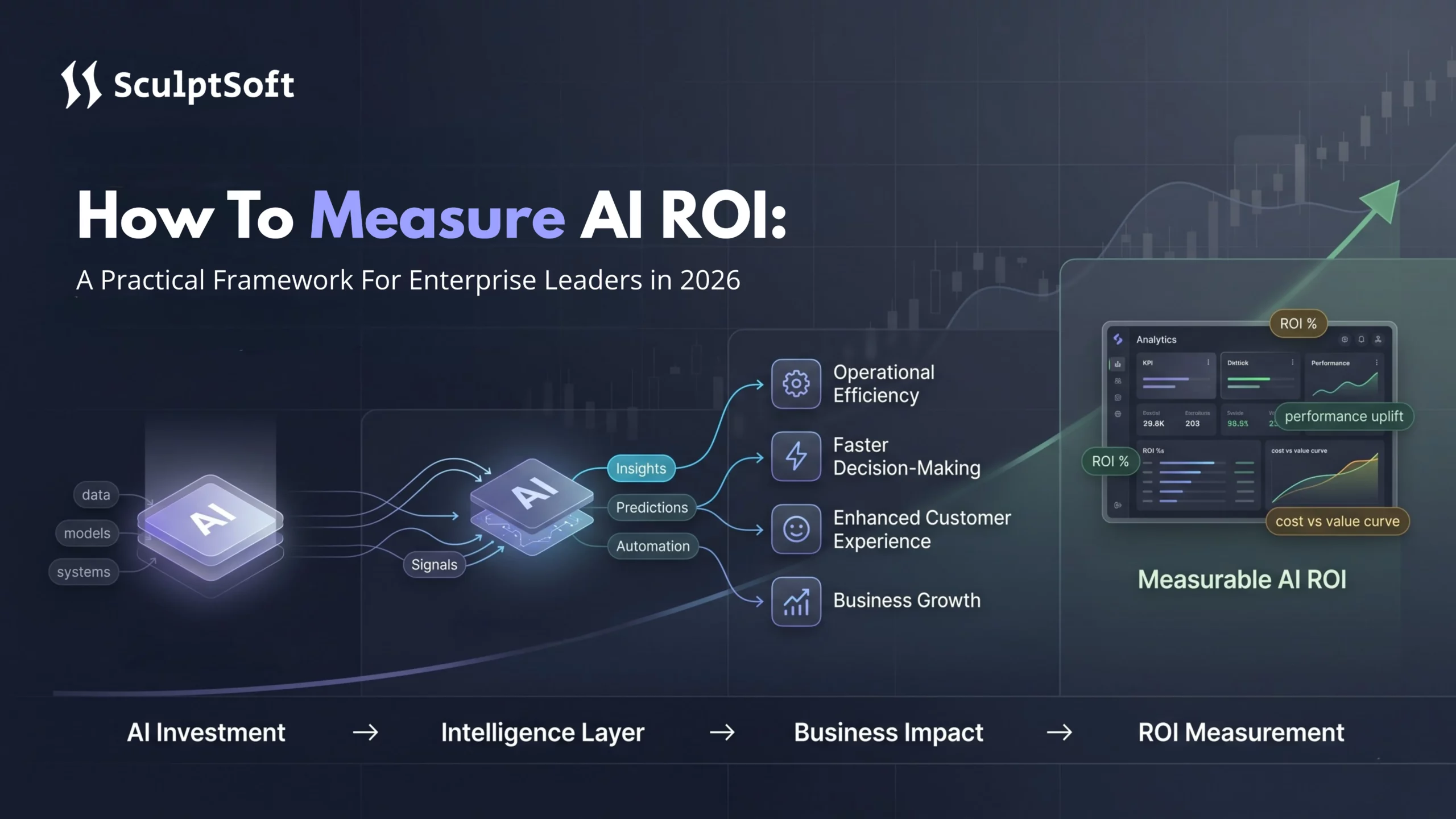
How to measure AI ROI is one of the most pressing questions enterprise leaders face as AI budgets grow faster than the evidence supporting them. Enterprises worldwide are increasing AI investment year over year, yet most still struggle to answer one fundamental question: what is this investment actually returning to the business?
According to IBM’s 2026 Enterprise AI Research, only 25% of AI initiatives deliver the expected ROI, and just 16% have successfully scaled across the enterprise.
The problem is not that AI is failing. The problem is that most enterprises lack a structured AI ROI framework to track what is working, where value is being created, and how to connect AI activity to boardroom-level business outcomes.
This blog breaks down a practical step-by-step framework for measuring AI ROI covering the right AI ROI metrics, real industry results, common measurement mistakes, and how to build an AI investment strategy that delivers results you can prove.
Why Do Most Enterprises Fail to Prove AI ROI?
Most enterprises cannot prove AI ROI because they measure the wrong things. They track how many AI tools are running, not what those tools are delivering to the business.
Deploying AI and measuring AI ROI are two completely different challenges. Many enterprise teams launch AI projects focused on getting the technology live, integrating systems, and training teams. Measurement gets deferred. By the time someone asks “what is this returning?”, there is no baseline, no attribution model, and no credible way to connect AI activity to real business outcomes.
The Growing Gap Between AI Spending and Measurable Business Returns
AI budgets are increasing every year across every industry. But larger investment without a structured AI ROI measurement framework produces the same result spending without proof.
These are the most common reasons enterprise leaders fail to measure AI return on investment:
- No Starting Point
Most AI projects begin without documenting current business performance levels. There is no record of what processes cost before AI, how long they took, or what error rates looked like. Without this pre-deployment picture, there is nothing credible to measure improvement against making it impossible to calculate real AI ROI after go-live.
- Tracking the Wrong Metrics
Enterprises that measure AI success through tool usage, login rates, and query volumes are measuring activity, not value. These metrics tell leadership how much AI is being used, not how much business value it is generating. Real AI ROI measurement connects AI performance to cost savings, revenue impact, and productivity improvement, not platform adoption numbers.
- No Unified Enterprise View
When each department tracks AI performance independently, the enterprise never sees the full picture. Finance tracks one set of numbers. Operations track another. Customer service tracks a third. This fragmented approach consistently underreports total AI business value and makes it impossible for leadership to build a unified, board-ready AI ROI case.
- No Clear Attribution Model
When business results improve after AI deployment, most enterprises cannot confirm with confidence that AI drove that improvement. Without a structured attribution model, leadership cannot distinguish between AI-driven gains and improvements caused by other business changes happening simultaneously weakening every AI investment conversation at board level.
Why Traditional ROI Formulas Fail for AI Investments
Standard ROI calculation works well for predictable investments – buy a machine, measure output, calculate return. AI does not work that way.
AI creates value gradually, across multiple workflows, and often in ways that do not show up immediately on a balance sheet. This is why measuring AI return on investment requires a purpose-built framework, not a formula borrowed from traditional IT projects.
The core differences that make AI ROI harder to measure:
- AI improves over time: Early-stage results significantly underrepresent the long-term value an AI system delivers as it processes more data and refines its performance
- AI impacts multiple teams simultaneously: Cost savings and productivity gains are distributed across departments rather than sitting in a single, easy-to-track budget line
- AI value is often indirect: Faster decision-making, fewer operational errors, and improved customer outcomes require their own dedicated tracking model to surface financial impact
- Poor data quality distorts results: When the underlying business data is inconsistent or incomplete, AI performance becomes harder to measure accurately and ROI figures lose credibility at board level
Knowing why AI ROI measurement breaks down is the foundation every enterprise leader needs. The next step is understanding what AI ROI actually means and how it differs fundamentally from the ROI your finance team already knows how to calculate.
What Is AI ROI and How Does It Differ from Traditional ROI?
AI ROI is the measurable business value an organisation receives from its AI investment relative to what it spent. It includes cost savings, revenue growth, productivity improvements, and better business decisions, measured against the total cost of building, deploying, and maintaining AI across the enterprise.
Understanding AI return on investment goes beyond a financial calculation. AI creates value across multiple areas of the business simultaneously, and that value compounds as the system processes more data and integrates deeper into core workflows.
This is what makes AI ROI fundamentally different from traditional ROI:
| Dimension | Traditional ROI | AI ROI |
|---|---|---|
| What it measures | One outcome from one fixed investment | Compounding value across operations, revenue, and risk simultaneously |
| How value appears | Immediately and predictably | Gradually, across multiple business functions |
| What drives returns | Doing existing tasks faster | Predicting risks, identifying opportunities, enabling decisions not previously possible |
| Measurement complexity | Single budget line | Multi-function attribution model required |
Dimension
What it measures
Traditional ROI
One outcome from one fixed investment
AI ROI
Compounding value across operations, revenue, and risk simultaneously
Dimension
How value appears
Traditional ROI
Immediately and predictably
AI ROI
Gradually, across multiple business functions
Dimension
What drives returns
Traditional ROI
Doing existing tasks faster
AI ROI
Predicting risks, identifying opportunities, enabling decisions not previously possible
Dimension
Measurement complexity
Traditional ROI
Single budget line
AI ROI
Multi-function attribution model required
Enterprise leaders who treat AI ROI as a long-term, multi-area business return, rather than a short-term cost saving, build the strongest and most defensible case for continued AI investment.
Understanding what AI ROI is sets the foundation. The next step is knowing how to calculate it.
How Do You Calculate AI ROI? The Formula and Metrics That Matter
Calculating AI ROI means comparing the total business value your AI generates against the total cost of building, deploying, and maintaining it. For enterprise leaders, the challenge is not the formula. It is identifying the right AI ROI metrics that connect AI performance to actual business outcomes.
The core AI ROI formula:
AI ROI (%) = [(Total Business Value Generated minus Total AI Investment Cost) divided by Total AI Investment Cost] multiplied by 100
Total AI investment cost goes beyond the initial build. It includes infrastructure, third-party licences, data preparation, system integration, team training, and ongoing maintenance. Enterprises that underestimate total cost of ownership consistently produce inflated ROI figures that do not hold under board scrutiny.
Total business value generated is where most enterprises lose clarity. AI value does not appear in a single budget line. It surfaces across multiple business functions simultaneously, which is why a structured AI ROI measurement framework must be in place before deployment begins.
Which AI ROI Metrics Actually Drive Enterprise Decisions?
Enterprise AI ROI measurement works across two dimensions that must be tracked together.
1. Financial Performance Metrics
These capture the direct, measurable business impact of AI investment:
- Operational cost reduction measures the decrease in the cost of running core business processes after AI deployment across the enterprise
- Revenue growth tracks the increase in revenue directly driven by AI powered sales, personalisation, and customer engagement
- Productivity improvement measures the increase in business output per employee before and after AI implementation
- Process completion speed captures the reduction in time taken to complete high-value business tasks after AI deployment
These metrics speak directly to business leaders and build the strongest case for continued AI investment at board level.
2. Strategic Performance Metrics
These capture the long-term business value that compounds over time:
- Customer retention improvement measures the increase in customer lifetime value driven by AI powered personalisation and service quality
- Risk and compliance cost reduction tracks the decrease in regulatory incidents, compliance overhead, and operational risk exposure across the enterprise
- Decision quality measures the improvement in the speed and accuracy of business decisions made using AI generated insights
- Market responsiveness captures how quickly the organisation identifies and responds to market changes using AI driven analytics
These metrics are harder to quantify immediately but represent the most significant long-term return on AI investment for enterprise leaders.
Tracking both financial and strategic AI ROI metrics together gives leadership a complete and defensible view of AI business value. One that satisfies every stakeholder from operations through to the boardroom.
What Returns Are Enterprises Actually Seeing from AI in 2026?
Enterprises investing in AI in 2026 are seeing measurable returns across three core areas. How quickly and how significantly those returns show up depends entirely on how well the AI implementation is aligned to specific business outcomes from day one.
1. Operational Cost Reduction
The most immediate and provable AI return on investment comes from operational efficiency. AI automates high-volume, repetitive business processes across customer support, document processing, supply chain management, and financial reconciliation.
The result is lower operational overhead, faster process completion, fewer human errors, and business output that scales without proportional increase in cost. For enterprise leaders, this is where AI ROI becomes most visible and easiest to defend at board level.
2. Revenue Growth and Customer Value
AI driven business value extends well beyond cost savings. Enterprises tracking AI return on investment across revenue functions are reporting higher customer retention through AI powered personalisation, improved sales conversion through intelligent automation, and faster identification of new market opportunities through predictive analytics.
This shift from viewing AI purely as a cost reduction tool to recognising it as a direct revenue growth driver is the most significant change in how enterprise leaders are measuring AI ROI in 2026.
3. Risk Reduction and Compliance Value
In regulated industries such as financial services, healthcare, and manufacturing, AI is delivering measurable returns through risk management and compliance automation. AI systems that monitor transactions in real time, flag anomalies early, and automate compliance reporting reduce regulatory exposure and the operational cost of staying compliant.
This is the category of AI business value that traditional ROI models most consistently undervalue and one that enterprise leaders cannot afford to leave out of their AI ROI measurement framework.
Custom AI vs Off-the-Shelf AI: Which Delivers Better ROI?
For enterprise leaders evaluating AI investment options, the choice between custom AI and off-the-shelf AI is one of the most important decisions that directly impacts long-term AI ROI.
What Does Off-the-Shelf AI Actually Cost Your Enterprise?
Off-the-shelf AI platforms offer speed at deployment. But for enterprises focused on maximising AI return on investment, that speed comes at a long-term cost.
- Vendor lock-in makes enterprises dependent on a single vendor’s pricing and platform roadmap, reducing control over AI investment costs over time
- Generic functionality means the platform is built for broad use cases, not for the specific workflows and business processes that drive ROI in your organisation
- Hidden costs including licensing fees, usage-based pricing, and mandatory upgrades consistently erode AI ROI in ways that are not visible at the point of purchase
- Scalability limits mean that as business needs grow, off-the-shelf platforms hit capability ceilings that require costly replacements
Why Does Custom AI Deliver Higher Long-Term ROI?
Custom AI is built around your specific business processes, proprietary data, and measurable outcomes. This is what makes the ROI difference significant at enterprise scale.
- Built for your outcomes: Every component is designed around the business goals and KPIs that matter to your organisation
- Full ownership and control: No vendor dependency, no recurring licence costs, no platform limitations as your business scales
- Seamless integration: with existing enterprise systems accelerates time to value and reduces total AI implementation cost
- Higher long-term ROI: Custom AI consistently delivers stronger, compounding returns because it is built to solve your exact business problems
Custom AI vs Off-the-Shelf AI: Side by Side Comparison
| Factor | Custom AI | Off-the-Shelf AI |
|---|---|---|
| Built for your business | Yes, designed around your specific processes and data | No, built for generic broad use cases |
| Vendor lock-in | None, full ownership and control | High, dependent on vendor roadmap and pricing |
| Integration with existing systems | Seamless, built around your infrastructure | Limited, frequent compatibility issues |
| Scalability | Scales with your business without cost escalation | Capability ceilings require costly upgrades |
| Long-term ROI | Higher compounding returns over time | Lower licensing and upgrade costs erode returns |
| Total cost of ownership | Predictable and controlled | Hidden costs escalate over time |
Factor
Built for your business
Custom AI
Yes, designed around your specific processes and data
Off-the-Shelf AI
No, built for generic broad use cases
Factor
Vendor lock-in
Custom AI
None, full ownership and control
Off-the-Shelf AI
High, dependent on vendor roadmap and pricing
Factor
Integration with existing systems
Custom AI
Seamless, built around your infrastructure
Off-the-Shelf AI
Limited, frequent compatibility issues
Factor
Scalability
Custom AI
Scales with your business without cost escalation
Off-the-Shelf AI
Capability ceilings require costly upgrades
Factor
Long-term ROI
Custom AI
Higher compounding returns over time
Off-the-Shelf AI
Lower licensing and upgrade costs erode returns
Factor
Total cost of ownership
Custom AI
Predictable and controlled
Off-the-Shelf AI
Hidden costs escalate over time
What Are the Most Common AI ROI Measurement Mistakes?
Most enterprises do not fail at AI because the technology does not work. They fail because they measure it incorrectly. These are the most common AI ROI measurement mistakes enterprise leaders make in 2026.
1. Tracking Activity Instead of Business Outcomes
Many enterprises measure how many AI tools are deployed, how many queries are processed, and how many users have adopted the platform. This tells leadership nothing about business value.
Avoid it by defining business outcome metrics before deployment begins. Every AI initiative needs success criteria tied directly to revenue growth, cost reduction, productivity improvement, and risk mitigation.
2. Starting Measurement After Deployment
Enterprises that begin tracking AI performance after go-live have no baseline to measure improvement against. Without knowing where the business stood before AI, there is no credible way to prove what AI has delivered.
Avoid it by documenting current business performance across every function AI will touch before the project begins. Pre-deployment measurement is the foundation of every reliable AI ROI framework.
3. Focusing Only on Financial Returns
Enterprises that track cost savings and revenue growth while ignoring decision quality, customer retention, and risk reduction consistently undervalue their total AI investment.
Avoid it by building a measurement model that tracks both financial performance and strategic business value together. This gives leadership the complete picture needed to justify and scale AI investment confidently.
4. Measuring AI Performance in Silos
When each department tracks AI ROI independently, the enterprise never sees the full picture and consistently underreports the true return on AI investment.
Avoid it by establishing a centralised AI ROI measurement framework that consolidates performance data across all business units into a single unified view at board level.
Avoiding these mistakes requires the right measurement strategy and the right implementation partner. SculptSoft is an AI software development company that helps enterprises build AI solutions with measurable outcomes, structured ROI frameworks, and full ownership from day one.
How SculptSoft Builds Custom AI Solutions That Deliver Measurable ROI
Measurable AI ROI does not come from deploying the most popular platform. It comes from building AI designed around your specific business processes, your data, and your outcomes with a measurement framework built in from day one.
SculptSoft is a custom AI and software development company helping enterprises across healthcare, financial services, manufacturing, and retail build AI that delivers returns they can prove.
Our enterprise AI capabilities include:
- Custom AI and Machine Learning development built around your business data and performance targets
- Agentic AI development that automates complex, multi-step business processes and reduces operational costs
- Data engineering and analytics that powers accurate AI performance and reliable ROI measurement
- Generative AI development designed for your specific industry and use case
Every solution we build gives enterprises full ownership and control, no vendor lock-in, no recurring licence costs, no capability ceilings as your business scales.
If your enterprise is investing in AI and needs a partner who builds for measurable outcomes, connect with our AI team today.
Final Thoughts
Measuring AI ROI is no longer optional for enterprise leaders. As AI investment grows, so does the pressure to prove what that investment is returning to the board, the business, and the bottom line.
The enterprises that succeed in 2026 are not necessarily the ones spending the most on AI. They are the ones that define the right AI ROI metrics before deployment, track business outcomes rather than activity, and build AI solutions designed around their specific business goals rather than generic off-the-shelf platforms.
A structured AI ROI measurement framework is what separates enterprises that confidently scale AI investment from those stuck justifying pilot projects that never reach their potential.
The difference between AI that costs money and AI that makes money is not technology, it is the strategy, the measurement, and the partner behind the implementation.
Frequently Asked Questions
How do you measure AI ROI?
Measure AI ROI by comparing the total business value AI generates cost savings, revenue growth, and productivity gains against the total cost of building, deploying, and maintaining it. Use the formula: AI ROI (%) = [(Total Value Generated – Total AI Cost) ÷ Total AI Cost] × 100.
What metrics are used to measure AI ROI?
The key AI ROI metrics include operational cost reduction, revenue growth, productivity improvement, process completion speed, customer retention, decision quality, and risk reduction. Tracking both financial and strategic metrics together gives enterprise leaders a complete and accurate picture of AI return on investment.
How long does it take for AI to show ROI?
Most enterprise AI implementations show measurable ROI within six to eighteen months. Operational efficiency gains appear earliest. Revenue growth and strategic returns compound over time as the AI system processes more data and integrates deeper into core business workflows.
What is the difference between AI ROI and AI value?
AI ROI is a specific financial calculation, the measurable return on what you spent on AI. AI value is broader and includes both financial returns and strategic benefits such as better decisions, reduced risk, and improved customer experience. Enterprise leaders need to measure both to get a complete picture of what their AI investment is delivering.
Why is AI ROI so hard to measure?
AI ROI is hard to measure because most enterprises track AI activity usage rates and tools deployed instead of business outcomes. The absence of a pre-deployment baseline is the biggest reason enterprises cannot prove what their AI investment is actually returning.
What is a good ROI for an AI project?
A good AI ROI depends on industry, use case, and scale. The most reliable benchmark is your own pre-deployment baseline, not an industry average. AI ROI that improves consistently quarter on quarter indicates a well-structured implementation aligned to real business outcomes.
How do I justify AI investment to the board?
Justify AI investment to the board by connecting AI performance to outcomes they already measure revenue growth, cost reduction, risk mitigation, and competitive positioning. A structured AI ROI measurement framework that tracks business outcomes from pre-deployment through to scale gives leadership clear, defensible evidence.