
Introduction
Scaling AI Agents in the enterprise is where most AI initiatives either prove their worth or quietly stall. Many organizations successfully run a pilot, see promising results in customer response times or back-office automation, and then struggle to translate that success into a full-scale production deployment. Gartner found that by the end of 2025, at least 50% of generative AI projects were abandoned after proof of concept due to poor data quality, escalating costs, or unclear business value.
The gap between pilot success and production deployment is where most AI investments burn through budget without delivering enterprise-wide value. The challenge is not just technical. It involves integrating with legacy systems, building governance frameworks, managing organizational change, and establishing the operational infrastructure that a pilot environment never requires.
This blog gives business leaders a practical, structured answer to the question of how to scale AI Agents in the enterprise. It covers what enterprise AI Agents actually are, the ten most common reasons AI Agent scaling fails, and a five-step deployment roadmap built for production-grade environments.
What Are Enterprise AI Agents and How Do They Actually Work?
Enterprise AI Agents are autonomous software systems that perceive data, reason through decisions, execute actions across connected systems, and adapt based on outcomes, all without constant human supervision. They differ from traditional automation by handling dynamic, unpredictable tasks rather than fixed, rule-based processes.
Enterprise AI Agents are built around five core components that make them fundamentally different from earlier automation tools.
- Perception and Data Intake
Unlike traditional automation, which processes only structured data, enterprise AI Agents can interpret unstructured inputs including emails, customer conversations, documents, and system logs. This broader data understanding allows them to act on a wider and more realistic range of business information.
- Reasoning and Decision-Making
AI Agents use machine learning models to analyze situations, weigh business rules, assess compliance requirements, and select appropriate actions. The reasoning layer is what allows agents to handle exceptions that would halt a traditional automated workflow.
- Action and System Integration
Once a decision is made, an AI Agent executes it directly, updating CRM records, triggering downstream workflows, scheduling follow-ups, or escalating issues, without manual intervention at each step.
- Learning and Adaptation
Modern AI Agents track outcomes and adjust their behavior based on feedback, whether from direct human review or patterns identified in business performance data. This is what allows agent quality to improve over time rather than degrade.
- Multi-Agent Coordination
At enterprise scale, multiple AI Agents typically operate simultaneously. One agent may handle customer support while another manages procurement. Coordination protocols determine how agents share context, prioritize actions, and avoid conflicts in high-stakes workflows.
How Do AI Agents Differ from Traditional Automation?
Traditional automation follows rigid, predefined rules and is ideal for repetitive, predictable tasks. AI Agents handle dynamic situations that require judgment, such as responding to complex customer queries, connecting data across systems, or managing exceptions that fall outside standard procedures.
The flexibility that makes AI Agents powerful is also what makes scaling them complex. An agent that performs well in a controlled pilot environment may encounter data inconsistencies, system edge cases, or volume demands it was never designed for in production.
Understanding these components is not just background knowledge. It is the foundation for making sound architectural and governance decisions before scaling begins.
Why Do AI Agents Fail to Scale in the Enterprise?
AI Agents fail to scale primarily because pilot environments do not replicate the data quality, infrastructure load, integration complexity, governance requirements, and operational demands of enterprise production. The ten reasons below account for the majority of failed scaling initiatives.
1. Infrastructure Built for Humans, Not Agents
Pilot infrastructure typically supports human users and batch processes. When AI Agents go live in production, they generate significant increases in API calls, database queries, and concurrent interactions. Many enterprises find their existing infrastructure cannot sustain this load, resulting in slower response times, system timeouts, and reliability failures.
2. Data Quality Problems Multiply at Scale
In a pilot, data is curated and quality issues are identified and corrected in advance. In production, data is messy, incomplete, and inconsistent. AI Agents trained on clean pilot data produce unreliable decisions when exposed to real production data environments.
3. Integration Complexity Grows Exponentially
A pilot may connect to two or three systems. A production deployment may involve dozens of enterprise applications, each with different APIs, data models, authentication requirements, and update frequencies. Managing these connections at scale requires architectural discipline that most pilots never develop.
4. Governance and Compliance Frameworks Are Absent
Pilots rarely operate under strict governance. Production deployments require clear decision authorities, audit trails, approval workflows, and compliance with regulations such as GDPR or HIPAA. Organizations that skip this foundation face delays, compliance violations, and blocked deployments.
5. Change Management Is Underestimated
Pilot teams are typically early adopters who welcome new technology. A production rollout reaches a much larger workforce, including employees who are concerned about how AI will affect their roles. Without a structured change management plan, resistance becomes a deployment barrier.
6. Performance Monitoring Does Not Scale
Monitoring a handful of metrics in a pilot is straightforward. In production, enterprises need continuous tracking of decision quality, accuracy drift, cost per action, escalation rates, and business KPI impact. Most pilot monitoring setups are not built for this.
7. Security and Access Controls Are Inadequate
Pilots often operate with elevated permissions to accelerate testing. Production AI Agents require granular access controls, identity management, and security policies that most security teams have not yet developed for autonomous systems.
8. Cost Models Break Under Production Volume
AI Agent operations are priced differently than traditional software, often per API call, token processed, or model inference. Costs that appear manageable in a pilot scale rapidly in production. Without cost monitoring and optimization built in from the start, production expenses frequently exceed forecasts.
9. Skills Gap Between Pilot and Production Teams
Pilots are typically built by data scientists and AI specialists. Moving to production requires a broader team including site reliability engineers, security architects, compliance specialists, and business process owners. Most organizations discover this skills gap only after deployment begins.
10. Edge Cases Overwhelm Human Review
Pilots handle predictable scenarios. Production environments expose AI Agents to unusual customer requests, conflicting data, and situations outside any documented workflow. If the fallback is to escalate to human reviewers, an unprepared review process becomes a bottleneck that undermines the value of the entire deployment.
Each of these failure points is preventable. The five-step roadmap in the next section addresses them in the order they need to be resolved.
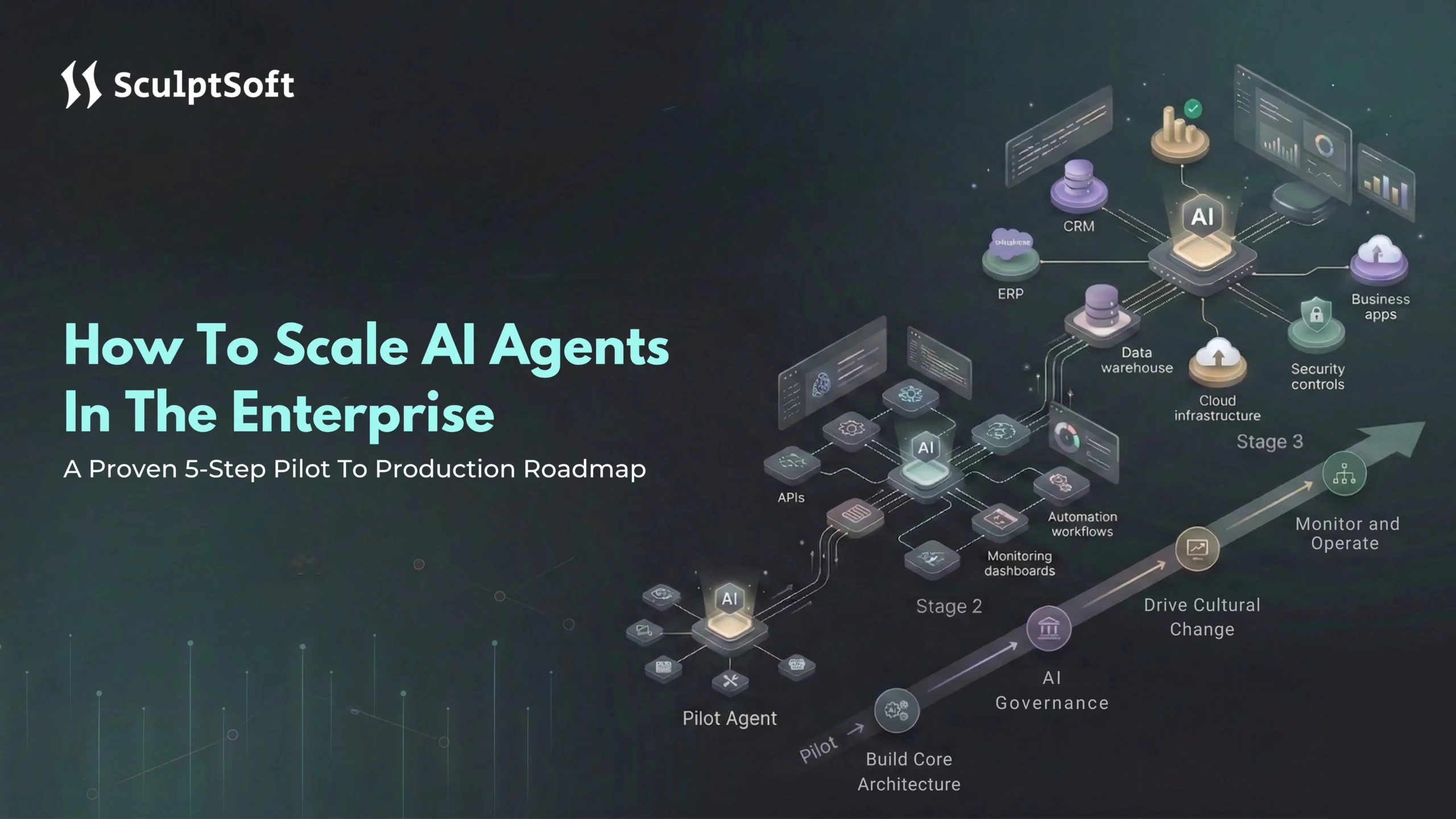
How to Scale AI Agents from Pilot to Production: The 5-Step Roadmap
Scaling AI Agents from pilot to production requires five structured steps: establishing the right architecture, implementing governance and oversight, driving organizational adoption, building production-grade monitoring, and scaling gradually with continuous validation. Each step addresses a distinct category of risk that pilots leave unresolved.
Step 1: Establish the Right Foundation and Architecture
Before expanding any pilot, the architectural foundation must be built for enterprise-scale agent operations. Decisions made at this stage determine the reliability, cost, and governance capacity of every subsequent deployment.
-
Map the Full AI Agent Ecosystem
Identify every system agents will interact with, every data source they will consume, every decision point that requires human oversight, and every existing workflow that needs to be redesigned. This mapping surfaces dependencies and constraints before they become production failures.
-
Design for Multi-Agent Coordination from Day One
Even if the initial deployment is a single agent, build communication protocols, shared context management, and conflict resolution into the architecture. Retrofitting multi-agent coordination after production deployment is significantly more expensive than designing for it upfront.
-
Build Resilient Integration Architecture
Use abstraction layers to isolate AI Agents from the complexity of underlying systems. Implement event-driven architectures, retry logic, circuit breakers, and graceful degradation so that a failure in one connected system does not cascade into a full agent outage.
-
Establish Data Governance Before Deployment
Define data ownership, quality standards, and pipeline monitoring before agents go live. AI Agents are only as reliable as the data they consume. Inconsistent or ungoverned data is one of the most common causes of production failure.
-
Model Infrastructure Capacity Realistically
AI Agents generate load patterns that traditional systems never create. Model API call volumes, database query rates, processing requirements, and storage needs based on production-scale assumptions, then add meaningful buffer capacity for unexpected spikes in agent activity.
Step 2: Implement Governance and Oversight
In production, AI Agents make decisions that directly affect business outcomes, customer relationships, and regulatory compliance. A governance framework is not optional at this stage.
-
Define Decision Authority Clearly
Specify which decisions agents can make autonomously, which require human approval, and which fall entirely outside agent scope. Document these boundaries in formats accessible to both technical teams and business stakeholders.
-
Create Auditable Action Logs
Log every agent action, including the data inputs, confidence levels, decisions made, and outcomes generated. These logs are essential for compliance, debugging, and maintaining organizational accountability for autonomous decisions.
-
Build Risk-Based Oversight Mechanisms
Apply human review selectively. High-impact decisions warrant review before execution. Lower-risk decisions can be validated through random sampling and automated anomaly detection. This approach maintains control without creating a human review bottleneck.
-
Embed Compliance Requirements Directly Into Agent Workflows
Whether the relevant regulations are HIPAA, GDPR, or industry-specific standards, compliance checks must be part of the agent workflow itself, not a post-deployment layer. Reactive compliance creates delays; proactive compliance enables faster scaling.
-
Develop Incident Response Protocols
Establish clear procedures for identifying agent errors, analyzing root causes, correcting the underlying issue, and communicating impact to affected stakeholders. Incident response that is defined in advance executes faster than incident response improvised under pressure.
Step 3: Drive Organizational Adoption
Scaling AI Agents is a change management challenge as much as a technical one. The organizations that succeed at enterprise AI adoption manage the human transition with the same rigor they apply to the technical deployment.
-
Set Accurate Expectations
Communicate clearly about what AI Agents can and cannot do. Overpromising capability creates disappointment and erodes trust. Underpromising leaves potential value unrealized. Accurate expectations enable teams to plan and adapt effectively.
-
Identify and Empower AI Champions
In every business unit affected by the deployment, identify team members who understand both the operational context and the potential of AI. Give them early access, provide structured support, and enable them to build peer credibility for the technology within their teams.
-
Redesign Workflows Rather Than Overlay Them
Adding AI Agents to existing processes without redesigning those processes rarely delivers the expected value. Identify where agents add speed, consistency, or accuracy that humans cannot match, and where humans add judgment, context, or relationship value that agents cannot replicate. Build handoff protocols between both.
-
Address Job Security Directly
Uncertainty about how AI will affect individual roles is a significant adoption barrier. Be direct about how roles will evolve. Invest in reskilling programs. Demonstrate through early results that AI Agents expand human capacity rather than eliminate it.
-
Measure and Communicate Early Wins
Share results that connect AI Agent performance to metrics that matter to business stakeholders, such as cost reduction, faster resolution times, higher customer satisfaction, and reduced error rates. Visible ROI builds organizational support for continued investment.
Step 4: Build Production-Grade Monitoring and Operations
Monitoring in production is fundamentally different from monitoring in a pilot. It must cover technical performance, business outcomes, cost efficiency, agent behavior drift, and operational readiness simultaneously.
-
Monitor Technical and Business Outcomes Together
Track system-level metrics such as response times, error rates, and uptime alongside business KPIs such as process completion rates, customer satisfaction scores, and cost per resolved interaction. Connecting technical performance to business impact allows the right problems to be prioritized.
-
Detect and Respond to Performance Drift
AI Agent performance degrades when data distributions shift, when system conditions change, or when business processes evolve. Establish performance baselines at launch and set automated alerts for meaningful deviations in accuracy, decision quality, or resolution rates.
-
Monitor Costs at the Action Level
Track costs per agent, per action type, and per business outcome. Identify high-cost operations that deliver disproportionately low value. Optimize model usage, caching strategies, and API call patterns to maintain cost efficiency as volume grows.
-
Build Structured Feedback Loops
Collect systematic feedback from human reviewers who handle escalated agent decisions. Use patterns in escalation data to identify which decision types need model improvement, workflow adjustment, or governance recalibration.
-
Create Operational Runbooks
Document standard operating procedures for every predictable operational scenario, including performance degradation, security incidents, model updates, and integration failures. Runbooks reduce resolution time and enable junior team members to maintain agent operations without escalating every issue.
Step 5: Scale Gradually with Continuous Validation
Enterprise AI Agent deployment is not a single launch event. It is a phased, continuously validated expansion that should remain reversible until each phase is proven stable.
-
Expand in Controlled Phases
Begin with low-risk processes, limited user groups, or constrained geographic regions. Validate performance, cost, compliance, and operational readiness at each phase before expanding. The cost of identifying a problem in phase two is a fraction of the cost of identifying it at full enterprise scale.
-
Define Go/No-Go Criteria Before Each Phase
Specify the accuracy thresholds, satisfaction scores, cost targets, and reliability standards that must be met before the next phase of deployment proceeds. Decisions to expand must be driven by data, not schedule pressure.
-
Build Rollback Capability Into Every Deployment
Design scaling architecture with kill switches that can halt malfunctioning agents and rollback procedures that can restore previous workflows. Scaling should remain reversible until each deployment phase has demonstrated production stability.
-
Run Parallel Operations During Transition
Maintain existing workflows alongside new AI-driven processes during each transition phase. Parallel operations enable direct outcome comparison and provide an operational safety net if agents produce unexpected results at a new scale.
-
Document Lessons Learned at Each Phase
Record what worked, what failed, and what surprised the team at every phase of the deployment. This institutional knowledge reduces risk in subsequent deployments and creates organizational capability that compounds across future AI initiatives.
Organizations that treat this roadmap as a checklist rather than a sequence will find the steps compound on each other. Governance built in step two only works because the architecture in step one was designed to support it. Monitoring in step four only delivers insight because the operational design in step two defines what to track.
How Are Leading Enterprises Scaling AI Agents Successfully?
The following examples illustrate how organizations in different industries have navigated the pilot-to-production transition. Client details are withheld to protect confidentiality.
Financial Services: Scaling Customer Operations AI
A financial institution found that while their pilot handled common customer inquiries effectively, production introduced complex regulatory scenarios the pilot architecture was not designed for.
The organization created specialized agents for distinct functions, including account inquiries, transaction disputes, product recommendations, and compliance documentation. A coordination layer was built to manage communication between agents and ensure no conflicting actions were taken across customer workflows. Critical to their success: dedicated agent sandbox testing environments that simulated real customer scenarios at scale before any production deployment, ensuring regulatory compliance and operational readiness before go-live.
Healthcare: Scaling Clinical Documentation Agents
A healthcare network piloted AI Agents that reduced physician administrative burden in a single department. Scaling across the full network required handling diverse clinical workflows and multiple electronic health record systems simultaneously.
The organization implemented a just-in-time data access model, ensuring agents accessed only the specific information required for each documentation task. All access was logged and auditable to meet privacy compliance requirements.
Their adoption approach centered on clinical staff trained to support peer adoption across departments, which accelerated organizational readiness significantly faster than a top-down rollout would have.
Manufacturing: Coordinating Supply Chain Intelligence
A global manufacturer began with demand forecasting and needed to extend AI Agent operations across procurement, production planning, logistics, and inventory management, functions that had historically operated without data coordination.
They built a shared operational context layer, giving each agent access to consistent real-time data across all four functions. This eliminated the data silos that had previously caused misaligned decisions between departments.
To bridge the skills gap between AI specialists and operations teams, they formed hybrid teams pairing supply chain experts with AI engineers, which proved critical to keeping technical solutions aligned with operational requirements.
Retail: Personalizing Customer Experiences at Scale
A retailer successfully piloted personalized product recommendations in a single test market. Extending this to thousands of locations and millions of customers across diverse product categories required a complete rethinking of the underlying AI architecture.
The team redesigned for performance, reducing redundant database queries, caching frequently accessed data, and precomputing common recommendation patterns to eliminate latency. They also repositioned AI tools as resources for store staff, which converted potential resistance into active support for the technology.
The common thread across these examples is not the technology. It is the decision to treat scaling as a structured organizational process rather than a technical rollout. Architecture, governance, and adoption planning were all addressed before each deployment reached full production.
How SculptSoft Helps Enterprises Scale AI Agents Faster
Scaling AI Agents from pilot to production requires a combination of skills that most enterprise teams do not have in a single group: machine learning expertise, enterprise integration architecture, security engineering, and governance design working together from the start.
SculptSoft is an AWS Select Tier Partner specializing in custom AI Agent development, enterprise system integration, and production-grade AI deployment. Our work spans Agentic AI, custom AI and ML, generative AI, and data engineering, giving our teams the cross-functional depth that enterprise AI scaling demands.
We design AI Agent architectures tailored to existing enterprise infrastructure, including legacy systems, cloud platforms, and hybrid environments. Beyond initial deployment, we provide the monitoring dashboards, incident response frameworks, and performance optimization tools that enable internal teams to manage and scale AI Agents independently over time.
Final Thoughts
Scaling AI Agents in the enterprise is genuinely hard, and the difficulty is rarely where organizations expect it to be. The technology itself is more mature than most enterprises realize. The gap is almost always in the foundations: data governance that was not built for production volume, integration architecture that was designed for a pilot, governance frameworks that were never established, and workforces that were not prepared for how their roles would change.
The five-step roadmap outlined here is designed to give any enterprise the sequence, the decision points, and the operational logic needed to make that transition without burning through budget or goodwill in the process. Start with architecture. Build governance in parallel. Manage adoption deliberately. Monitor for business outcomes, not just technical metrics. And scale in phases that can be validated and reversed if needed.
The enterprises that deploy AI Agents as reliable, production-grade systems rather than perpetual pilots will hold a durable operational advantage. The window to build that advantage is open now, but it closes as competitors move from experimentation to execution.
If your organization is navigating this transition, contact us now to discuss how we can support your pilot-to-production roadmap.
Frequently Asked Questions
How do you measure ROI when scaling AI Agents in production?
ROI from enterprise AI Agents is measured across cost reduction, productivity gains, and customer outcome improvements. Track cost per resolved interaction, process completion rates, and escalation frequency against pre-deployment baselines. Connecting technical performance to business metrics ensures ROI is attributable rather than estimated.
What infrastructure is required to scale AI Agents at enterprise level?
Enterprise AI Agent infrastructure requires an API gateway for concurrent agent requests, event-driven integration architecture to decouple agents from underlying systems, governed real-time data pipelines, and observability tooling that tracks agent behavior alongside business outcomes. Cloud-native platforms such as AWS provide the elastic capacity production workloads demand.
What governance framework do enterprise AI Agents need before going to production?
Enterprise AI Agents require four governance elements: defined decision authority boundaries, auditable action logs recording every decision and its inputs, embedded compliance checks for regulations such as GDPR or HIPAA, and documented incident response protocols covering error identification, correction, and stakeholder communication. All four must be in place before production deployment.
How do you prevent AI Agent performance from degrading after deployment?
Performance degrades when data distributions shift or business processes evolve. Prevention requires performance baselines at launch, automated monitoring for deviations in decision accuracy and escalation rates, structured feedback loops from human reviewers, and model reviews triggered by performance thresholds rather than fixed calendar schedules.