Introduction
Most AI conversations inside a company eventually reach the same question: should we build this ourselves, or buy something that already exists? It sounds like a procurement decision. In practice, it shapes:
- how quickly the capability reaches users
- who controls the data moving through it
- how well it fits existing systems
- what the business will still be paying for years later
The Build vs Buy AI decision is getting difficult to clearly define. With foundation models, AI APIs, and customizable platforms, building rarely begins from scratch. Buying rarely ends with a monthly charge, and there are many instances where both can be utilized.
This is a guide for how you make your choice. You’ll look at what really matters; what will help determine your decision: What makes you different from others (differentiation)? Do you have the data needed (data)? Can you integrate with other systems (integration)? Is it safe enough (security)? How much will it cost over time (cost over time)? Do you have the right people inside your company to support this (expertise)? And finally, who owns it for the next 5-10 years (long-term ownership)? Your goal should be to find an option that fits the problem you’re trying to solve – not because you want to.
What Build vs Buy AI Actually Means for a Business?
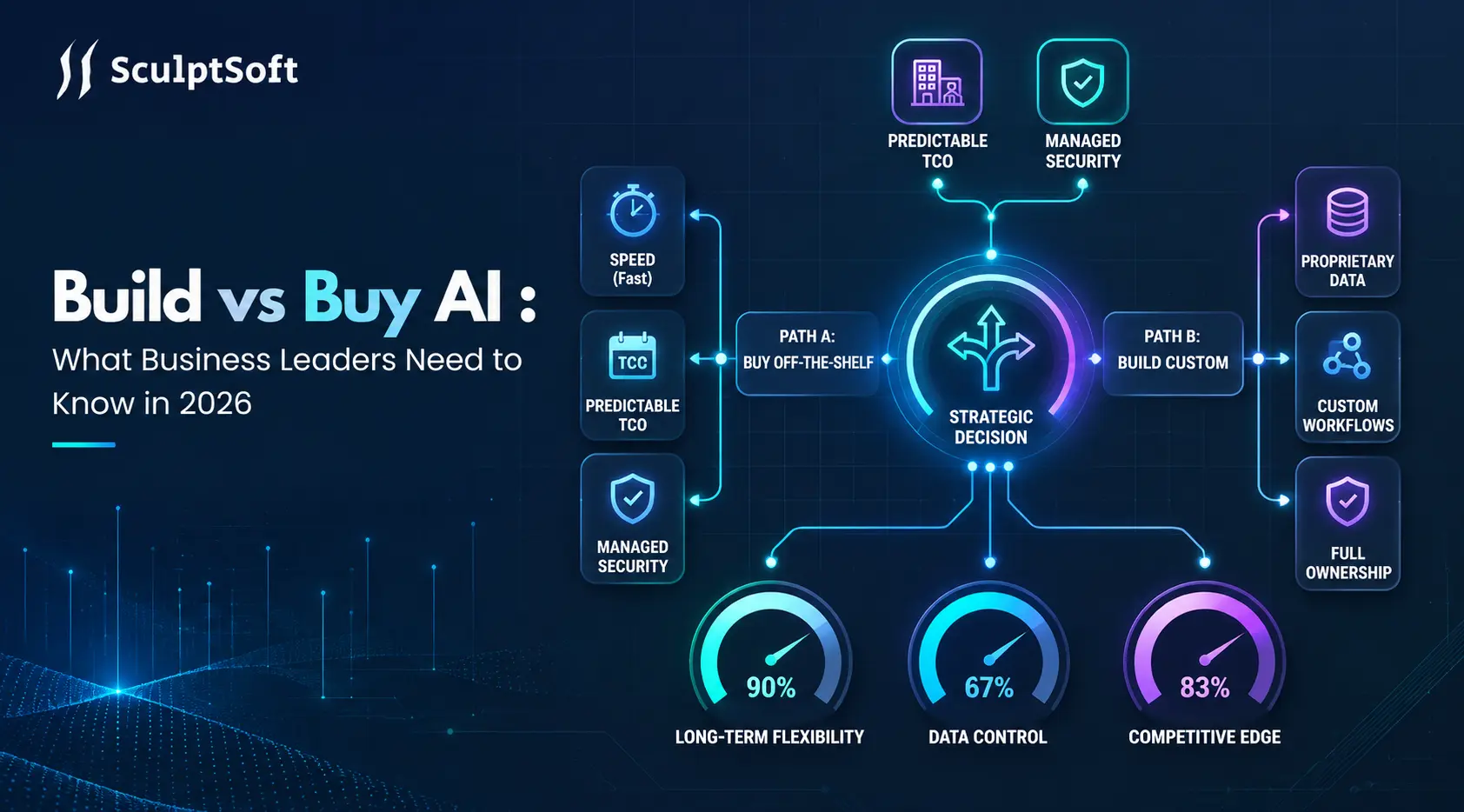
The “build vs. buy” decision is typically presented as a choice between two distinct paths; however, a large number of AI-related projects are positioned within a range of possibilities, from fully built to completely purchased. Companies can purchase access to an AI foundation model, develop the associated processes/workflows, and utilize managed cloud services to operate the model. Viewing the options along a continuum helps companies determine what elements of the solution they will need to control directly.
- Buy as-is: an AI product used largely out of the box, such as a support copilot or a document-processing tool.
- Buy and configure: an AI platform extended with your prompts, connectors, and workflow rules.
- Build on foundation models: a custom application layer, grounded in your own data, on Stop of commercial or open-weight foundation models that are accessed through APIs or self-hosted.
- Build custom machine learning: models trained or fine-tuned on proprietary data, such as a demand-forecasting or fraud-scoring model.
- Partner-led build: an external team designs and delivers the solution, with ownership of the code and models set by contract.
When viewed in this manner, the relevant question is changed from “do we develop/build or purchase/license?” to “what layers do we need to control/own internally and what layers can we rent/lease or use as a service?”
When Buying Off-the-Shelf AI Solutions Makes Sense?
When you need to solve an issue that is common across your company, with a workflow that follows a standard pattern, then off-the-shelf AI solutions will generally be your best option. Examples of off-the-shelf AI solutions include: • meeting summaries • general writing assistance • AI features within a popular CRM or help desk application. Custom software development is typically unnecessary for these types of applications. It is often much better to buy an off-the-shelf solution. Buying an off-the-shelf solution is particularly advantageous if your organization lacks internal AI/ML expertise, and you need the solution implemented within weeks (rather than months). Additionally, with off-the-shelf solutions, the vendor will typically handle model updates, hosting, and support.
“Buy is faster” is only true if the details hold up. Before signing, verify:
- Implementation time: realistic go-live timelines for companies of your size.
- Integration effort: which systems connect natively and which need custom work.
- Data work: migration, cleanup, and permissions setup.
- Security review: how long your review will take and what documentation the vendor provides.
- Customization limits: what can and cannot be changed.
- Pricing at scale: per-seat versus usage-based pricing as adoption grows.
Vendor claims deserve the same scrutiny, especially around AI agents. According to Gartner’s agentic AI forecast, only about 130 of the thousands of agentic AI vendors are real. Gartner describes the problem as “agent washing”: rebranding AI assistants, robotic process automation (RPA) tools, and chatbots as agents without substantial agentic capabilities. Ask for a proof of concept on your own data, not a scripted demo.
Gartner estimates that 33% of enterprise software applications will contain agentic AI capabilities by the end of 2028 (this number was under 1% in 2024). This means there is a good chance that many of the features contained within your current software license have an agentic component and, as such, should receive a similar evaluation.
The limits of this option are also very clear. In order to utilize this option, you must change your work processes; the vendor owns the product’s roadmap; and competition can purchase the exact same capabilities.
When Custom AI Development Is the Better Investment?
Custom AI development earns its cost when the capability is part of how the business competes. It is typically justified when:
- proprietary data is central to the value
- the workflow is unusual
- the solution needs deep integrations
- deployment constraints apply, such as a virtual private cloud (VPC), on-premises deployment, or data-residency requirements
- the use case needs specialized machine learning, such as predictions built on your own transaction history
Building rarely involves pretraining a foundation model. Most custom solutions combine existing components:
- foundation models, accessed via API or self-hosted
- retrieval-augmented generation (RAG) over company knowledge
- agentic workflows and custom orchestration
- business logic
- data pipelines
- evaluation and monitoring
- custom interfaces
You get to control everything from what your system looks like (architecture) to which model you use to analyze the data (model selection), to how the data moves through the system (data flow), to the security measures in place (security controls), to where the system runs (deployment environment), and how it will change in the future.
A virtual body measurement tool that SculptSoft built for a German fashion and apparel company shows what this looks like in practice. Rather than building pose detection from scratch, the team used MoveNet, a pretrained TensorFlow pose-detection model, to validate the front and side photos that customers take on their smartphones.
The custom work was built around that model:
- measurement calculation
- size recommendations mapped to the client’s brand-specific sizing charts
- GDPR-compliant data handling
- integration into the client’s e-commerce platform
The published outcomes include a 75% reduction in returns.
The results of a custom build depend heavily on data quality. A custom system is only as reliable as the pipelines feeding it, which is why data engineering foundations for AI deserve attention before any model work begins. The trade-off is ownership: after launch, maintenance, monitoring, and improvement all fall to you.
Build vs Buy AI: Key Factors Decision-Makers Compare
This chart will help you compare these two types of approaches by examining the key elements used to determine whether or not an artificial intelligence project is successful. Each line should be viewed as a trade-off, not a judgement. What is best for your company depends upon the lines that are most important to the specific application you want to implement and how willing you are to take risks on those lines.
| Factor | Build | Buy |
|---|---|---|
| Time to deployment | Typically longer; depends on scope and data readiness | Often shorter, if integration and security review go smoothly |
| Initial investment | Typically higher engineering cost upfront | Lower upfront; recurring fees |
| Customization | Shaped around your workflow | Limited to what the vendor exposes |
| Integration | Built around your systems and APIs | Depends on available connectors and APIs |
| Data control | You define flows, storage, and retention | Governed by vendor terms and architecture |
| Security control | You design the controls and must maintain them | You configure what the vendor exposes and verify the rest |
| Scalability | You plan capacity, rate limits, and infrastructure | Vendor-managed; cost may rise with usage |
| Maintenance | Your team or partner | Mostly the vendor; you maintain configuration and integrations |
| Vendor dependency | Reduced at the application layer; model and cloud provider dependency remains | Higher |
| Internal expertise | Needed, in-house or via a partner | Lower at launch; still needed for integration and oversight |
| Long-term flexibility | High, limited mainly by budget and team capacity | Tied to the vendor roadmap |
| Model control | You choose, test, and switch models | Vendor selects and updates models; choice is often limited |
Factor
Time to deployment
Build
Typically longer; depends on scope and data readiness
Buy
Often shorter, if integration and security review go smoothly
Factor
Initial investment
Build
Typically higher engineering cost upfront
Buy
Lower upfront; recurring fees
Factor
Customization
Build
Shaped around your workflow
Buy
Limited to what the vendor exposes
Factor
Integration
Build
Built around your systems and APIs
Buy
Depends on available connectors and APIs
Factor
Data control
Build
You define flows, storage, and retention
Buy
Governed by vendor terms and architecture
Factor
Security control
Build
You design the controls and must maintain them
Buy
You configure what the vendor exposes and verify the rest
Factor
Scalability
Build
You plan capacity, rate limits, and infrastructure
Buy
Vendor-managed; cost may rise with usage
Factor
Maintenance
Build
Your team or partner
Buy
Mostly the vendor; you maintain configuration and integrations
Factor
Vendor dependency
Build
Reduced at the application layer; model and cloud provider dependency remains
Buy
Higher
Factor
Internal expertise
Build
Needed, in-house or via a partner
Buy
Lower at launch; still needed for integration and oversight
Factor
Long-term flexibility
Build
High, limited mainly by budget and team capacity
Buy
Tied to the vendor roadmap
Factor
Model control
Build
You choose, test, and switch models
Buy
Vendor selects and updates models; choice is often limited
Neither column is universally better. Building is not automatically more secure, and buying is not automatically cheaper.
Cost, Security, Integration, and Long-Term Ownership
A comparison table shows where the options differ. It doesn’t show how much each difference will cost, how much risk it carries, or how hard it will be to live with. These four areas are where build vs buy decisions tend to go wrong, because the real impact appears only after launch.
Total Cost of Ownership
Comparing a subscription price against a development quote alone is a common way this decision goes wrong. A fair comparison covers several years and every cost category:
- Upfront: development, integration, data preparation, security review, and testing.
- Recurring: licensing, model inference (API tokens or self-hosted GPU capacity), infrastructure, monitoring, and support.
- Easy to miss: internal engineering time, evaluation work, retraining or re-tuning, and the cost of switching vendors later.
Generative AI adds a cost variable that is harder to predict than seat-based licensing. Model APIs are typically priced per token; input and output tokens are priced separately, and output tokens usually cost more. Longer prompts, retrieved context, and longer responses all increase the cost per request.
Agentic systems can make multiple model calls, plus tool calls, to complete a single task, so the same workflow can cost very different amounts depending on its design. SculptSoft’s guide to cost control for agentic AI workflows covers this in more depth.
Cost can end projects outright. In the same forecast, Gartner predicts that over 40% of agentic AI projects will be canceled by the end of 2027, due to escalating costs, unclear business value, or inadequate risk controls.
A practical step is to model total cost at three usage levels: pilot, expected adoption, and complete success. Options that look cheap at pilot scale often rank differently at full adoption.
Security, Privacy, and Governance
Buying an AI product does not transfer accountability for how your data is handled. Your business still answers to customers, auditors, and regulators for what happens to that data. That makes vendor due diligence part of the security work rather than a procurement formality.
Ask any vendor:
- Is our data used to train or improve your models?
- What are your retention and deletion policies?
- Where is our data processed and stored?
- What access controls, audit logs, and encryption in transit and at rest do you provide?
- Can you provide a SOC 2 Type II report, or evidence of ISO/IEC 27001 or ISO/IEC 42001 certification?
- Which subprocessors, including model providers, process our data?
- How, and how quickly, do you report security incidents to customers?
These questions are not theoretical. IBM’s 2025 Cost of a Data Breach Report draws on breaches experienced by 600 organizations globally between March 2024 and February 2025. It found:
- 13% of organizations reported breaches of AI models or applications.
- 97% of those organizations reported lacking proper AI access controls.
- 63% of breached organizations either had no AI governance policy or were still developing one.
Building shifts the work rather than removing it. You define the controls, but you also have to implement them: role-based access control, human review for high-impact outputs, audit logging, input and output guardrails, and ongoing monitoring. For the policies behind these controls, see SculptSoft’s piece on AI governance and transparency.
Integration Complexity
Enterprise AI solutions rarely operate in isolation. A useful assistant usually needs to:
- read from a CRM, ERP, or knowledge base
- authenticate users through single sign-on (SSO) and enforce their existing permissions
- write results back into existing workflow tools
Permissions alone can decide the outcome. Take a support assistant that retrieves account history. It needs permission-aware retrieval, meaning it surfaces only the records each user is authorized to see. That rule has to be enforced in the retrieval layer at query time, not merely hidden in the user interface. If a vendor cannot enforce your permission model, the product may be unusable no matter how good its model is.
Integration requirements often shape the build itself. For a furniture business, SculptSoft built an AI-powered e-commerce chatbot that captures leads in real time, syncs them to Zoho CRM and Google Sheets, and hands complex queries to live agents. Integration was part of the core requirement: the client needed the chatbot to work across its website and social media channels rather than operate as a standalone tool.
Third-party components bring their own risk. NIST’s Generative AI Profile, published in July 2024, identifies 12 risks that are unique to or exacerbated by generative AI. One of them, value chain and component integration, covers upstream third-party components, including data, that are integrated without enough transparency, traceability, or supplier vetting. That risk applies whether you buy a finished product or build on external models.
As AI technology advances from providing responses to initiating actions, the risk involved in employing AI technology increases. For example, when the AI is given responsibilities to perform tasks that include actions like updating records or sending emails, such AI must be given only limited access to resources it requires for completing its assignments.
Before running any AI application, the engineering team must ensure that they have enough proof of API documentation. The engineers should also check the availability of rates for the system as well as the support it provides through webhooks and a sandbox for testing integrations.
Scalability, Model Changes, and Ownership
Purchasing transfers the responsibility for things like infrastructure development and scaling onto the vendor. Furthermore, the vendor would be making the choices regarding things like pricing, changing features, and selecting models. Building this responsibility gives you that decision-making responsibility along with the operational work that goes with it, which includes monitoring performance, versioning models and prompts, evaluating the outputs, and keeping the technical debt under control.
Even solutions built on commercial APIs are not static. Anthropic’s model deprecation documentation states that:
- older models are retired regularly
- requests to a retired model fail
- customers with active deployments receive at least 60 days’ notice before a publicly released model is retired
Claude Opus 4.1, for example, was deprecated on June 5, 2026, and retired on August 5, 2026. Partner platforms such as Amazon Bedrock and Google Cloud set their own retirement schedules, so dates can differ depending on where a model is accessed.
In practice, any AI system built on third-party models needs:
- a regression evaluation suite that tests a new model against your real tasks before you switch
- a model-agnostic abstraction layer, so models can be swapped with minimal application changes
A generative AI analytics chatbot that SculptSoft built for a UK finance-sector client uses a multi-model architecture. The client provides data analytics to its own customers, and the chatbot answers those customers’ plain-language questions about their data. It combines OpenAI GPT-4 and Amazon Titan models, orchestrated through LangChain with an Amazon OpenSearch Serverless vector store. Orchestration frameworks such as LangChain provide a common interface across model providers, which helps keep the model layer separate from business logic.
Custom machine learning adds another duty: monitoring data drift and concept drift, and retraining models as business conditions change.
The Hybrid Approach: License the Model, Build the Workflow
For many organizations, the most practical answer is to license or buy the commodity layers and build the differentiating ones. Common patterns include:
- Licensing foundation model access while building the application, retrieval, and workflow layers.
- Using a commercial AI platform while developing custom workflows on top of it.
- Pairing third-party APIs with proprietary data pipelines.
- Buying managed ML infrastructure, such as Amazon SageMaker or Google Cloud Vertex AI, while building specialized models.
- Using SaaS AI tools for general productivity while custom-building the workflows that set the business apart.
An AI-powered call center for healthcare that SculptSoft built for a US provider follows this pattern. The foundation layers were licensed: a GPT-4 model for conversation handling and call summarization, and Twilio for voice calls and messaging. The custom layers made the system fit the provider’s operations: intent-based call routing, escalation of urgent cases to the on-call nurse, appointment management, and EHR/EMR integration. The published outcomes include a 60% reduction in nurses’ administrative tasks.
Choosing the model layer is its own decision. A comparison of leading enterprise AI models helps frame it.
A hybrid approach is not free of trade-offs. Its weak points are the integration points between vendor and custom components, where responsibility for data handling, failure recovery, and cost can blur. Make that ownership explicit early.
A Practical Build vs Buy Framework for AI Decisions
Once the factors are clear, the next step is turning them into a decision. The questions below help leadership and engineering teams test a use case against the conditions that favor building, buying, or combining both. Answer them with evidence from pilots, vendor proofs of concept, and cost models rather than assumptions or sales promises.
| Question | If Yes, Consider | Why |
|---|---|---|
| Is the capability strategically differentiating? | Build or customize | Control over behavior and roadmap matters |
| Is the requirement standardized? | Buy | Existing functionality is likely sufficient |
| Are integrations highly specialized? | Build or customize | Connectors may not cover your systems |
| Is speed critical? | Buy or hybrid | Existing capabilities shorten time-to-value |
| Is sensitive proprietary data central? | Build or customize | Tighter control over data flows may be required |
| Is internal AI/ML expertise limited? | Buy or partner | Reduces implementation burden |
| Would a vendor price or feature change hurt badly? | Build or hybrid | Reduces dependence on a single vendor’s roadmap |
Question
Is the capability strategically differentiating?
If Yes, Consider
Build or customize
Why
Control over behavior and roadmap matters
Question
Is the requirement standardized?
If Yes, Consider
Buy
Why
Existing functionality is likely sufficient
Question
Are integrations highly specialized?
If Yes, Consider
Build or customize
Why
Connectors may not cover your systems
Question
Is speed critical?
If Yes, Consider
Buy or hybrid
Why
Existing capabilities shorten time-to-value
Question
Is sensitive proprietary data central?
If Yes, Consider
Build or customize
Why
Tighter control over data flows may be required
Question
Is internal AI/ML expertise limited?
If Yes, Consider
Buy or partner
Why
Reduces implementation burden
Question
Would a vendor price or feature change hurt badly?
If Yes, Consider
Build or hybrid
Why
Reduces dependence on a single vendor’s roadmap
Consider this approach as a means for conflict identification rather than a scoring system. Differentiation and urgency of capabilities are not mutually exclusive; therefore, in this situation, the most sincere response would be purchase now with an exit strategy and build later.
Questions to Ask Before You Decide
Many build-vs-buy failures happen not because of the wrong choice but due to the way this choice was made. A team chooses the right strategy for all the wrong reasons, or omits some steps in order to realize flaws in their strategy earlier. The following mistakes are committed regularly by teams working on AI projects.
- Differentiation: Would competitors gain the same advantage by buying the same tool?
- Data: How sensitive is the data, and is it clean and complete enough to use?
- Integration: Which systems must the solution read from or write to?
- Cost: What is the multi-year total cost at expected usage?
- Expertise: Who will run and improve this after launch?
- Vendor dependency: What happens if pricing, features, or the underlying model change?
- Exit strategy: Can we export our data, prompts, and configurations if we leave?
- Success: What measurable outcome defines success?
When Working With an AI/ML Development Partner Helps?
Some decisions point toward building, but the team to build it doesn’t exist yet. External expertise tends to help when:
- internal AI/ML experience is thin
- integrations span several enterprise systems
- the solution needs production-grade deployment, security controls, and MLOps/LLMOps practices for monitoring and updates, rather than a prototype
- the work involves generative AI applications, AI agents, or custom machine learning built around proprietary data
An ERP software company, for example, worked with SculptSoft to add AI support inside its own product. The resulting AI chat assistant for an ERP platform gives paying users answers retrieved from a knowledge base of product documentation. The published outcomes include an 85% reduction in query resolution time.
In cases like these, specialized AI/ML development services can cover architecture, integration, evaluation, deployment, and long-term maintenance while the internal team builds its own capability.
Judge partners on evidence, not claims. Look for:
- how they test and evaluate AI outputs
- how they handle security review
- who owns the code and models
- how they transfer knowledge to your team
Common Build vs Buy AI Mistakes That Cost Businesses
Build vs. Buy decision failures often stem more from the process itself rather than the decision that is taken. People make good decisions for bad reasons, or simply leave out steps that could have revealed issues early on in the process. These issues occur again and again in AI projects, yet they are avoidable.
- Choosing on initial price instead of total cost of ownership.
- Building before validating that the use case is worth solving.
- Buying without testing integrations against real systems.
- Assuming an AI product works well out of the box on your data.
- Ignoring data quality until results disappoint.
- Launching without success metrics.
- Underestimating governance, evaluation, and monitoring.
Each of these is a decision failure rather than a technology failure, a pattern SculptSoft explores further in its analysis of why most AI projects fail.
Conclusion
There are no one-size-fits-all decisions in Build vs. Buy for AI. Buying works best for common problems where fast implementation is critical but not differentiating. Building works for capabilities based on unique data or workflows or any other competitive advantages. A hybrid approach is often more practical.
Most balanced decisions take into account differentiation, data sensitivity, extent of integration, multi-year costs, and post-launch ownership of the solution. Validation of the use case via a pilot project with concrete KPIs is also an important part of the process.
In cases where custom AI/ML development is required as a result of the decisions made, SculptSoft partners with businesses to create, integrate, and support AI solutions based on their own data and systems. A scoping conversation is a reasonable next step after the use case is validated.
Frequently Asked Questions
Is it cheaper to build or buy an AI solution?
Purchasing normally comes at a lower cost initially. Construction can prove to be cheaper where the level of usage is higher, requirements of customization deeper or costs of subscription increase with increased use.
Does building AI mean training our own model?
In generative AI use cases, seldom. In most custom development efforts, there is use of existing foundation models with additional functionality for retrieval, business logic, integration, and evaluation, and fine-tuning only for cases where prompt and retrieval don’t work well enough. Use cases like prediction that need forecasting or fraud scoring are an exception where your model must be trained on your data.
What are the biggest risks of buying an AI product?
These include inadequate personalization, reliance on the provider’s roadmap and pricing, integration issues, and data management terms that do not necessarily align with your needs.
What are the biggest risks of building an AI solution?
The primary challenges include underestimating time, data preparation, and ownership, which encompasses monitoring, model updates, and security maintenance.
Should startups build or buy AI?
It is good for startups to purchase the commodity competencies because their engineering efforts should focus on the product-specific AI competencies.
What is a hybrid build vs buy AI strategy?
It means licensing the commodity layers, such as foundation models or infrastructure, and building the differentiating parts: workflows, data pipelines, and integrations.