
Introduction
Creating a multi-agent AI architecture for an organization is a completely different story compared to making sure the prototype works in a confined space. The demo may reveal that there are multiple agents able to think, utilize tools, and collaborate to achieve the goal.
However, when running the software in production, authentication, workflow compliance, API limitations, legacy integration, auditing, data security, and cost management become equally important.
This is where enterprise AI becomes an architectural challenge, not just a model-selection exercise. A multi-agent system combines language models with orchestration logic, business rules, APIs, databases, identity and access controls, observability, and human oversight.
This layer of AI is based on probability because it is possible for the same input to generate different outputs at each iteration. There is, thus, a need for the rest of the architecture to have well-defined limits concerning what the agents are able to do and how they use their tools.
A robust enterprise architecture should not attempt to remove the variability in its processes. It rather handles the variability using well-defined responsibilities, access to tools, validation, observation, and escalation.
This guide will take you through the development of a multi-agent AI system on the basis of these principles, including the roles of agents and their orchestration, security and access control, observability, and evaluation.
What Multi-Agent AI Looks Like Inside an Enterprise
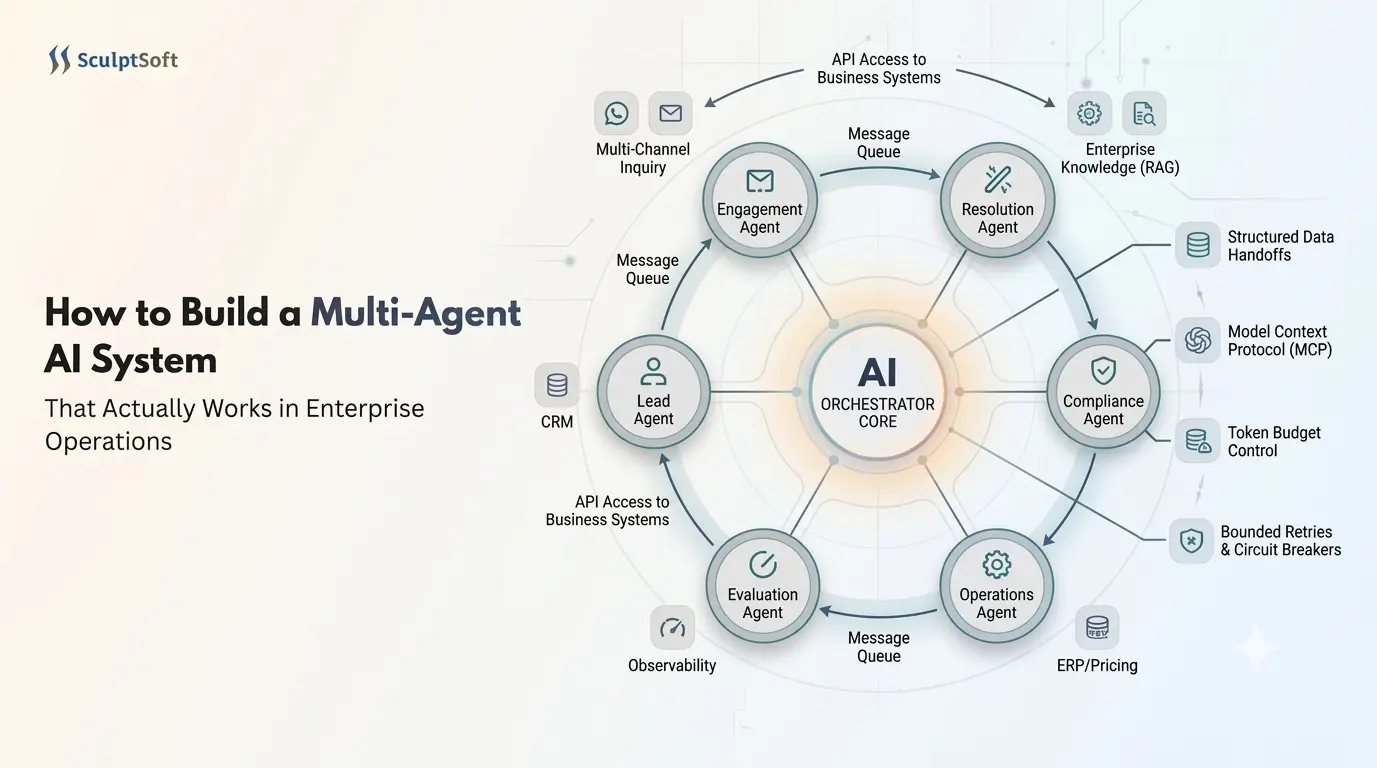
What is a multi-agent AI system in enterprise operations? Multi-Agent AI Architecture refers to the scenario in which many AI-based agents work together to complete the processes involved in an enterprise workflow. The individual agents may each have their own set of instructions, tools, environment and even permissions, but it is the orchestration layer that assigns tasks, coordinates communications and carries out task executions.
The AI agent is usually a language model-based component operating in an iterative cycle, where the agent gets a goal, picks an action, invokes a tool, sees the output, and determines how to proceed further. The multi-agent system consists of multiple such cycles that have their unique set of instructions, tools, and context window, which refers to the restricted amount of data that AI is able to process. There is a layer of coordination, generally referred to as the orchestrator, which is responsible for managing the agents’ work.
Agents, tools, and the decision loop
A tool is any capability you deliberately hand to the agent: pulling a customer record, checking stock, searching a policy document, raising a service ticket. The AI decides which tool to use and what information to send to it. The tool performs the requested operation, while the agent’s ability to act remains bounded by the tools and permissions it has been given. Defining that tool list is therefore an architectural decision rather than a late implementation detail.
Why more agents rarely mean a better system
Every extra agent adds a handover, and every handover is a place where context gets shortened, dropped, or misread. Anthropic’s engineering team reported that a multi-agent configuration outperformed a single-agent one by 90.2% on its internal research evaluations, but specifically on work that can be split into independent tasks that happen at the same time, such as checking stock, reviewing customer history, and calculating pricing. Where each step depends heavily on the one before it, adding agents often increases coordination overhead and can reduce reliability rather than improve it.
When a Multi-Agent Architecture Is Actually Justified
This question needs to come up right at the beginning of the engagement, prior to creating any sort of architecture diagram, since the honest answer most likely will be no. Many agents add value to the process where there is true parallelism with respect to either different tools or different data. They do not add value where there is only a sequential process involved.
Single-Agent vs Multi-Agent AI Systems: Technical Comparison
Prior to developing a multi-agent system, a team needs to decide whether there is a need to use more than one component in its reasoning process. The use of the single-agent approach is enough for specific tasks; however, the development of a multi-agent system becomes justified when some work can be distributed among the agents.
| Area | Single-Agent AI System | Multi-Agent AI System |
|---|---|---|
| Architecture | One agent handles the workflow. | Multiple specialized agents work together. |
| Task Complexity | Best for focused, straightforward workflows. | Best for complex or specialized workflows. |
| Decision Making | One reasoning loop plans and executes tasks. | Multiple agents reason, delegate, and collaborate. |
| Tools & Access | One agent typically manages the required tools. | Agents can have different tools and permissions. |
| Communication | Minimal agent-to-agent communication. | Requires structured handoffs or shared state. |
| Development & Cost | Simpler and usually less expensive. | More complex and usually more expensive. |
| Security & Control | Fewer permissions and boundaries to manage. | Requires stronger agent-level access controls. |
| Best Fit | Focused tasks one agent can complete. | Workflows requiring specialization, multiple systems, or parallel tasks. |
Area
Architecture
Single-Agent AI System
One agent handles the workflow.
Multi-Agent AI System
Multiple specialized agents work together.
Area
Task Complexity
Single-Agent AI System
Best for focused, straightforward workflows.
Multi-Agent AI System
Best for complex or specialized workflows.
Area
Decision Making
Single-Agent AI System
One reasoning loop plans and executes tasks.
Multi-Agent AI System
Multiple agents reason, delegate, and collaborate.
Area
Tools & Access
Single-Agent AI System
One agent typically manages the required tools.
Multi-Agent AI System
Agents can have different tools and permissions.
Area
Communication
Single-Agent AI System
Minimal agent-to-agent communication.
Multi-Agent AI System
Requires structured handoffs or shared state.
Area
Development & Cost
Single-Agent AI System
Simpler and usually less expensive.
Multi-Agent AI System
More complex and usually more expensive.
Area
Security & Control
Single-Agent AI System
Fewer permissions and boundaries to manage.
Multi-Agent AI System
Requires stronger agent-level access controls.
Area
Best Fit
Single-Agent AI System
Focused tasks one agent can complete.
Multi-Agent AI System
Workflows requiring specialization, multiple systems, or parallel tasks.
How to Decide Whether the Work Really Needs Multiple Agents?
When should an enterprise use a multi-agent AI architecture? An enterprise should consider a multi-agent AI architecture when a workflow can be divided into independent or specialized tasks that require different tools, data sources, permissions, or reasoning responsibilities. If the workflow is mostly sequential and can be handled by one reasoning loop or deterministic business rules, a single-agent or conventional workflow architecture may be simpler and more efficient.
These three questions answer most of the issues. Is there a way to break down the activity such that it can be done through independent branches? Does each branch require a unique set of tools or a unique level of permissions? Will an experienced individual from that department say it is actually multiple activities instead of one? If most of the answers are no, it would be faster and cheaper to construct and explain a single agent or workflow engine to an auditor.
The cost of over-engineering the architecture
An unnecessary multi-agent design does more than consume budget. It introduces handovers that lose context, failure paths that are hard to trace back to a cause, and more systems and data access for your security team to review. Teams that skip this assessment frequently rebuild the same system as a single agent two quarters later, having paid twice to reach one conclusion.
Recognizing when one agent is sufficient
If the task is one question answered from a body of documents, a single well-grounded assistant beats a committee of them. SculptSoft’s AI chat assistant for an ERP platform is that shape: one AI assistant answering user questions from a searchable knowledge base built from the client’s own product documentation. It is not a multi-agent system, and the problem it addresses does not call for one.
Where Multi-Agent Systems Fit Best
- Intent Agent: Classifies customer requests and determines the required workflow path.
- Knowledge Agent: Retrieves relevant information from enterprise documentation using RAG.
- Resolution Agent: Generates responses or recommends next actions based on retrieved context.
- Escalation Agent: Routes complex cases to human teams or specialized workflows.
Orchestration Patterns and Specialist Agent Design
How do you build a production-ready multi-agent AI system? Build a production-ready multi-agent AI system by defining agent responsibilities, selecting an appropriate orchestration pattern, restricting tool access, establishing structured communication contracts, grounding agents with trusted enterprise data, and keeping deterministic business rules outside the model. Production systems should also include observability, evaluation, bounded retries, cost controls, human approval gates, and audit trails.
Start with the operational process, not the framework. Write down the steps a capable employee performs today, mark which need judgement and which follow fixed rules, then find the specific points where a model changes the outcome. What emerges is usually a smaller system than the one sketched on day one.
Supervisor and planner-executor patterns
A supervisor agent takes the request, routes each part to the right specialist, and assembles the result. It is essentially the dispatching job a workflow engine already does, with model-based judgement added. A planner-executor design goes further: one component writes an explicit plan, another carries it out step by step. Because that plan is stored rather than implied, it can be logged, capped, reviewed, and replayed, which is what makes an unpredictable system diagnosable. SculptSoft’s guide to LangChain deep agents walks through how these coordination layers behave in practice.
Define Agents by What They Can Do, Not by Job Titles
Define each specialist by the tools and data it needs, not by a role name lifted from the org chart. A quotation agent that reads a live pricing service is a real boundary with a real permission set behind it. A “strategy agent” is a label with nothing underneath. Narrow scope keeps the model’s instructions short, keeps testing focused, and keeps access rights small enough that someone can actually review them.
Shared state, message queues, and event-driven flows
Agent Communication, APIs, and Tool Calling
Use Structured Data Instead of Free-Text Messages
Enterprise APIs and the Model Context Protocol
RAG and Grounding Agents in Enterprise Knowledge
A model reasoning over outdated or irrelevant source material produces answers that read beautifully and are wrong. Retrieval-augmented generation, usually shortened to RAG, anchors the reasoning: before the model answers, the system retrieves relevant passages from your own policies, manuals, contracts, and records and puts them in front of it. How well that retrieval layer is engineered often determines whether the system is still trusted six months after launch, and it is the foundation of most serious generative AI development work in an enterprise setting.
Retrieval quality determines answer quality
Context windows, memory, and persistent state
Where Deterministic Software Must Stay in Control
Transactions, constraints, and compliance logic
Human approval gates on high-impact actions
Sensitive or high-value steps should stop and wait for a person. In the multi-agent sales and order automation platform SculptSoft built for a retail and manufacturing client, specialist agents coordinated by a LangGraph orchestrator handled inquiry capture, requirement analysis, product recommendation, and quotation, while payment details were verified through a human-in-the-loop step before invoice and billing workflows were triggered. The client reported a 60% reduction in manual sales effort.
Security and Permission Boundaries for AI Agents
How do you secure a multi-agent AI system? Secure the multi-agent AI system through providing each individual agent with its own identity as well as granting it access only to the resources necessary for carrying out its duties. This would involve external authorization of the system, verification of input to tools, treating retrieved content as untrusted, protecting sensitive data, monitoring the agent’s behavior, and human authorization of risky actions.
Least privilege through RBAC and ABAC
Prompt injection and data exposure
Any text an agent reads a retrieved document, an inbound email, a web page, a response from a tool can carry instructions planted to redirect its behaviour. This is prompt injection, and it is the defining new risk of agentic systems. The OWASP GenAI LLM Top 10, which maps its risk categories to frameworks including NIST and MITRE ATLAS, is a practical basis for threat modelling. Treat all retrieved content as untrusted, restrict tool parameters to validated values, and strip sensitive fields before they enter the context window.
Observability, Tracing, and Agent Evaluation
Tracing a request across every agent hop
Record every agent step, tool call, retrieval, and retry under one shared trace identifier, capturing what went in, what came out, and how long each stage took. Established practice from DevSecOps and monitoring transfers directly: an agent run is a single request travelling through many services, distinguished mainly by unusually large payloads and far more variation between two identical inputs.
Evaluating outcomes rather than step sequences
Failure Modes, Cost, and Latency in Production
Recurring failure modes in multi-agent systems
Researchers at UC Berkeley examined recorded runs across seven multi-agent frameworks and catalogued 14 distinct failure modes in three groups: specification issues, where instructions or roles are unclear; inter-agent misalignment, where agents drift out of step with one another; and task verification, where completed work goes unchecked. The full multi-agent failure taxonomy repays reading before an architecture is signed off. Circular delegation is a familiar example: agents free to hand work to each other eventually pass it in circles or redo finished steps, which routing through a supervisor in one direction and recording completed steps both prevent.
Timeouts, bounded retries, and circuit breakers
Model routing and token budgets
Moving From Prototype to Production
Gartner has forecast that more than 40% of agentic AI projects will be cancelled by the end of 2027, citing escalating costs, unclear business value, and inadequate risk controls. The same analysis is direct about scope: “Many use cases positioned as agentic today don’t require agentic implementations,” noted Gartner analyst Anushree Verma. The full agentic AI project forecast sets out the reasoning behind the number.
Starting with one process and a measured baseline
Operating it as a production service
Agent systems need a named owner, agreed targets for reliability and response time, version control over prompts and tool definitions, staged rollouts, a complete record of every action and approval for audit, and a rollback path someone has actually tested. Treat a prompt change as a code change, with review and re-testing, because functionally that is what it is. Sustaining this over years depends on steady AI and ML development capacity rather than a project team that disperses at launch.
Conclusion
Most of the difficulty, in practice, sits outside the model entirely: integrations with ERP and CRM platforms, permission design, retrieval quality, tracing, and the production controls that keep a probabilistic component away from irreversible decisions. If you are weighing whether a multi-agent design fits a specific process in your business, that question is worth working through with engineers who have built and operated these systems before committing to a build. You can talk to our team about the architecture, the integration surface, and what a realistic first production slice would involve.