
Introduction
Healthcare has spent nearly thirty years going digital. Electronic health records, billing platforms, and clinical documentation tools are everywhere now. Yet the industry’s operational efficiency has not improved at the pace of its technology adoption.
The numbers are uncomfortable. Administrative costs now consume an estimated 25% to 35% of all healthcare spending in the United States. That is not a technology problem. That is a workflow problem.
Healthcare organizations still rely on fragmented systems, manual handoffs, and repetitive administrative tasks. Staff often move information between platforms, adding unnecessary steps to already complex workflows.
More data and more software have not necessarily improved coordination or accelerated decision-making. Instead, they can create more information for already stretched teams to manage every day.
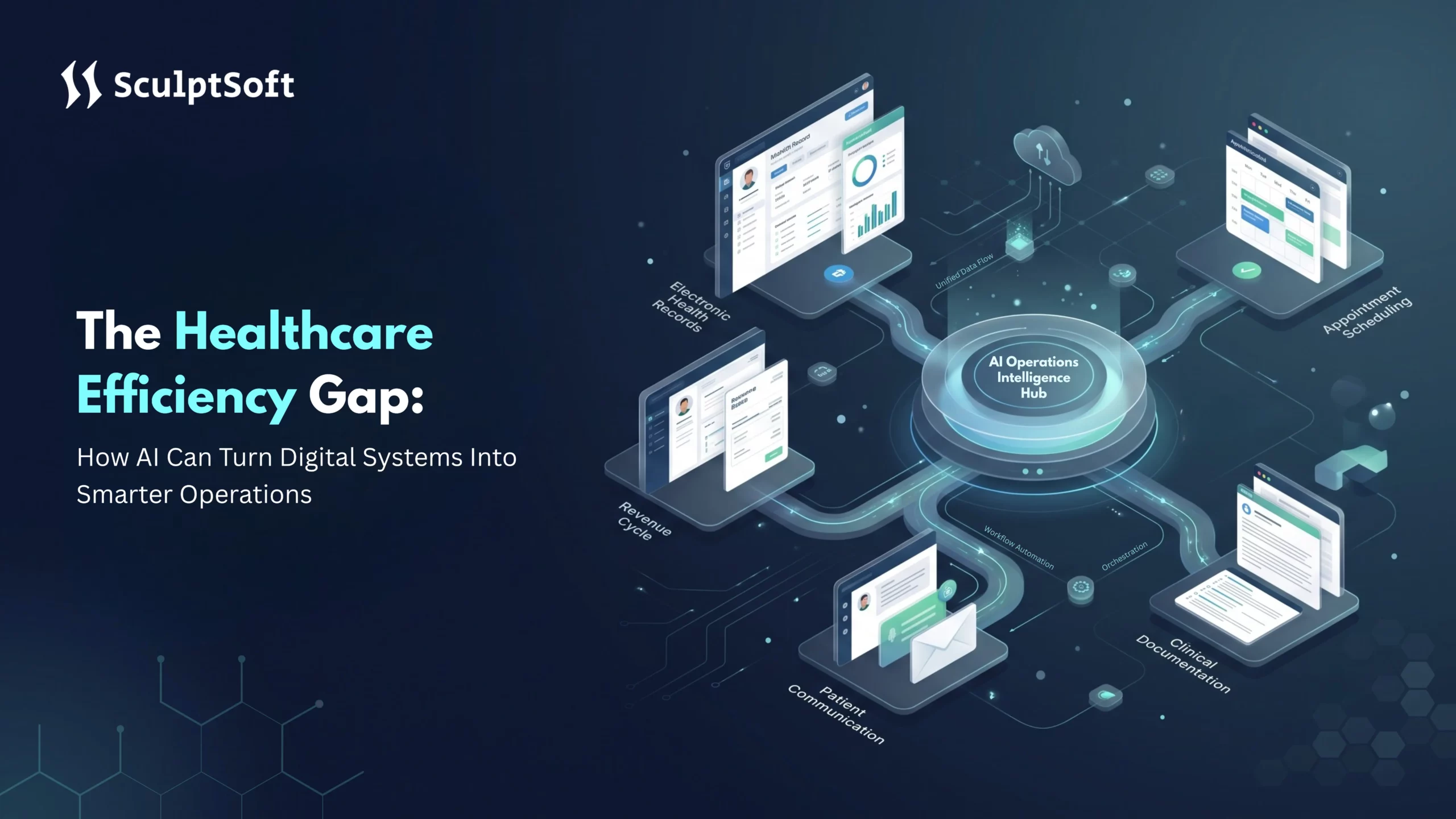
The challenge is no longer simply having digital tools. Healthcare needs to turn its data and technology into timely, coordinated action without adding more complexity.
The gap between digital infrastructure and operational intelligence is where healthcare loses time, money, and clinical focus. AI is the bridge, but only when it is applied to the right problems with the right governance.
Why Digital Systems Alone Don't Fix Inefficiency
Digital systems store data. They do not interpret it. A hospital can have a fully digitized EHR and still drown in prior authorization requests, duplicate documentation, and fragmented care coordination.
Consider the financial weight. Hospitals spent $43 billion in 2025 trying to collect payments insurers owed for care already delivered, according to the AHA’s annual Costs of Caring report, Nearly $18 billion of that went toward overturning denied claims alone. Prior authorization, claims denials, and repeated documentation requests have turned revenue cycle management into a war of attrition.
Now consider the clinical side. A 2025 study of nursing documentation at Canada’s largest academic mental health hospital found that nurses spent a mean of 19.3 minutes per patient per shift on EHR activity in inpatient settings. For Registered Practical Nurses, that climbed to 20.1 minutes. Multiply that across a career, a unit, a hospital system.
The inefficiency is not hypothetical. It is measured, documented, and felt every shift.
The AI Readiness Gap: Pilots vs. Production
Healthcare leaders know AI matters. But knowing and deploying are different.
A CII-PwC report released in September 2026 found that while 64% of healthcare leaders have piloted AI applications, only 11% have moved them into production. Data quality, not budget, was the leading barrier.
That gap matters because pilots rarely deliver enterprise-level returns. The value of AI comes from scale, from embedding intelligence into workflows that touch thousands of decisions daily.
Mount Sinai Health System offers a counterexample. The New York-based system estimates a $50 million bottom-line impact from its AI portfolio this year, reporting more than a 3-to-1 return on investment. But the ROI did not come from a single breakthrough. It came from governance, measurable metrics, and a willingness to fail fast.
“One of the biggest lessons we’ve learned is the importance of defining objective success criteria before a pilot begins,” said Robbie Freeman, DNP, RN, chief digital transformation officer at Mount Sinai.
Where AI Actually Moves the Needle
The most compelling AI applications in healthcare are not the flashiest. They are the ones that remove friction from existing processes.
Scheduling: The Quiet Revenue Leak
Appointment no-shows and inefficient waitlist management are among the most overlooked drains in outpatient care. Staff spend hours calling patients who never pick up, while open slots sit empty.
When a healthcare provider automated this with an AI appointment scheduling system, the results were not marginal. Manual effort fell by 78%. Patient satisfaction rose by 80%. Slot utilization improved by 70%. The system predicted no-shows and refilled slots before they went to waste.
Patient Communication: The After-Hours Problem
A single on-call nurse managing every after-hours inquiry is a recipe for burnout and delayed care. One provider faced exactly that, with routine questions competing against genuine emergencies for the same limited attention.
Deploying an AI-powered call center system for healthcare changed the math. Administrative tasks dropped by 60%, patient satisfaction climbed by 75%, and urgent calls reached a clinician while routine ones were resolved automatically. The nurse got their nights back. Patients got faster answers.
Visibility: You Cannot Fix What You Cannot See
Latency is the quietest killer of digital healthcare experiences. A hospital running AI-driven call workflows had no idea where patients were waiting or which steps were slow. Raw telemetry sat unused, and issues surfaced only when someone complained.
That changed with a latency insights framework for hospitals. End-to-end visibility improved by 65%. Bottleneck detection got 50% faster. Diagnosis time for slow steps fell by 45%. Once the hospital could see the gaps, it could close them.
Documentation and Data Migration
A 2026 study published in JAMIA Open described an LLM-driven workflow that migrated colonoscopy recall recommendations from unstructured reports during an EHR transition. The system processed 118,181 records in approximately nine hours at a direct implementation cost of roughly $12,000. Manual review of the same volume would have taken months.
The accuracy was not perfect, but it was superior to traditional rule-based NLP. More importantly, it preserved longitudinal care continuity during a high-risk transition.
Revenue Cycle and Administrative Automation
Analysts at the Peterson Health Technology Institute have warned that AI applied to prior authorization and billing without process redesign can create “bot wars,” automated systems on both payer and provider sides engaging in high-volume, low-value exchanges. The technology reduces per-decision cost but not necessarily system-level cost.
The lesson: AI is not a substitute for fixing broken incentives. It is an accelerant. Applied to streamlined processes, it compounds efficiency. Applied to fragmented processes, it compounds waste.
Why Healthcare AI Needs Governance Before It Scales
The World Health Organization has been explicit about the stakes. According to a 2026 statement from WHO Regional Director for Europe Dr. Hans Henri P. Kluge, only 8% of countries in the European Region have a health-specific AI strategy, even as nearly two-thirds deploy AI in diagnostics.
That imbalance creates a serious problem. Healthcare organizations are adopting AI faster than they are building the frameworks needed to validate, monitor, and manage its use. A system that performs well in a controlled environment can behave differently when exposed to incomplete data, changing workflows, or real-world patient populations.
“The longer governance lags behind deployment, the higher the human cost,” Kluge said. “A biased algorithm can produce a wrong diagnosis, for a real patient, with real consequences.”
Governance also becomes more important as AI moves beyond isolated pilots and into everyday operations. Organizations need to know who is responsible for an AI-driven decision, how performance is monitored, when human review is required, and what happens when the system produces an unexpected result. These controls are especially important when AI influences clinical decisions, patient communication, scheduling, or other workflows where errors can affect care and operations.
Governance is not bureaucracy. It is the mechanism that helps ensure AI improves care without introducing new risks. It requires validation, transparency, accountability, ongoing monitoring, and clear human oversight. Without those foundations, scaling AI can simply scale the consequences of an unreliable process.
The Shift from Systems of Record to Systems of Intelligence
Healthcare has invested heavily in systems of record. The next decade belongs to systems of intelligence, tools that not only store data but interpret it, route it, and act on it.
That shift is already visible in the market. The global generative AI in healthcare market is expanding across drug discovery, clinical documentation, patient engagement, and administrative automation. Partnerships between healthcare organizations and technology providers are accelerating adoption.
The real transformation happens when intelligence becomes part of everyday workflows, connecting information across systems and helping teams act before delays become larger operational problems.
Instead of simply recording what happened, intelligent systems can identify patterns, surface exceptions, prioritize tasks, and support faster decisions. That changes technology from a passive repository into an active layer of operational support.
But the organizations that capture value will be those that treat AI as an operational discipline, not a procurement decision.
If you’re still wrestling with the fundamentals of where AI fits in your administrative stack, this breakdown of AI in healthcare administrative bottlenecks is worth reading before you scale anything.
How Healthcare Organizations Can Close the Efficiency Gap
The healthcare efficiency gap will not close on its own. Digital systems alone have not done it. Adding more technology without redesigning workflows will not do it either.
What works is unglamorous: mapping the friction, measuring the time, applying AI to specific bottlenecks, and governing the deployment with clear metrics. That is how Mount Sinai generated $50 million in value. That is how 118,000 records moved in nine hours. That is how a hospital finally saw its own latency.
The starting point is not selecting an AI tool. It is identifying where teams lose time, where information gets stuck, and where repetitive work consistently slows patient care.
From there, organizations can prioritize workflows with measurable outcomes, test targeted AI solutions, and expand only when the results justify broader deployment. Small, measurable improvements can become meaningful operational gains at scale. The tools exist. The evidence is accumulating. The remaining question is whether healthcare organizations will treat AI as a curiosity or as the operational backbone it can become.
The gap is real. The bridge is available.
Conclusion
The healthcare efficiency gap will not close on its own. Digital systems alone have not solved it. Adding more technology without fixing workflows will not solve it either.
What works is simple work: finding the slow spots, measuring the time lost, applying AI to specific problems, and setting clear rules for deployment. That is how Mount Sinai created $50 million in value. That is how 118,000 records moved in nine hours. That is how a hospital finally saw its own delays.
Start with one workflow. Measure the time it takes. Apply AI to the bottleneck. Then scale what works. Every minute saved on paperwork is a minute returned to patient care. The organizations that win will treat efficiency as a daily practice, not a one-time project.
The tools exist. The proof is growing. The only question left is whether healthcare organizations will treat AI as a side project or as a core part of daily operations. The gap is real. The fix is ready.