
Introduction
Most patients never think about how appointment scheduling works. They only notice it when something goes wrong: a phone line that stays busy, a callback that never comes, or a reminder that arrives too late to help. Clinic teams feel the strain as well. They spend hours confirming visits, chasing cancellations, and updating records by hand, often while open slots go unused.
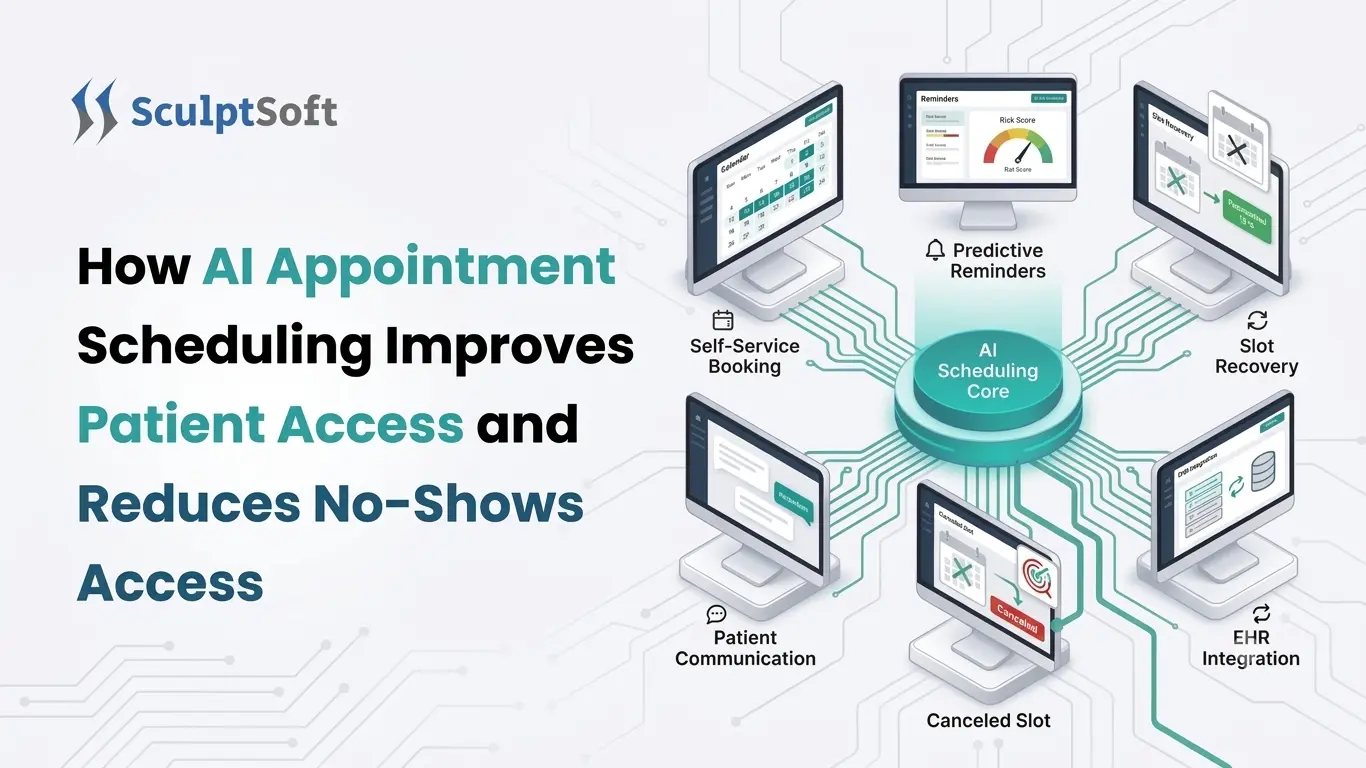
AI appointment scheduling is a technology that uses machine learning and automated workflows to manage patient bookings, predict no-shows, and synchronize with Electronic Health Records (EHR) in real time. It fixes this workflow from end to end by supporting each step:
- Booking without long hold times
- Reminders that reach higher-risk patients first
- Cancellations that trigger slot recovery
- Rescheduling that keeps patients engaged
- EHR sync that keeps every appointment accurate
This blog walks through each step, the evidence behind it, and why integration often decides whether a scheduling project succeeds.
Modern healthcare scheduling requires more than simply replacing phone calls with online calendars. AI-driven systems analyze operational patterns, patient behavior, provider availability, and historical appointment data to create a more responsive scheduling environment. By combining automation with predictive analytics, healthcare organizations can improve resource utilization while maintaining a smoother experience for both patients and administrative teams.
Why Patient Access Starts with the Scheduling Workflow?
Getting a physician appointment has become harder for many patients. The AMN Healthcare wait time survey found that patients in 15 large metropolitan areas now wait an average of 31 days for a physician appointment. That wait is 19% longer than in 2022 and 48% longer than in 2004. Leah Grant, president of AMN Healthcare’s Physician Solutions division, said that wait times are “the longest they have been since we began conducting the survey.”
Physician shortages are one contributing factor. However, inefficient scheduling can compound the problem. When booking, reminders, and cancellations are managed by hand, three issues tend to appear:
- Late cancellations remain unfilled.
- Waitlisted patients are not contacted in time.
- Appointment data drifts out of sync with the EHR.
Each issue wastes existing capacity and reflects the wider administrative bottlenecks that slow down healthcare teams. Fixing the scheduling workflow is a practical way to recover that capacity.
A connected scheduling workflow also improves visibility across departments by creating a single source of truth for appointment availability. Front-desk teams, physicians, and care coordinators can access updated information without depending on manual spreadsheets or repeated confirmation calls. This reduces scheduling conflicts, improves operational coordination, and helps healthcare organizations deliver faster access without increasing administrative workload.
Self-Service Booking That Removes Patient Friction
Access begins with the first booking attempt. Experian Health’s State of Patient Access 2026 found that seeing a practitioner quickly has been the most common patient challenge for four consecutive years. The survey also revealed a perception gap: 46% of providers said access had improved, while only 18% of patients agreed. Around two-thirds of organizations that invested in digital, mobile, and self-service scheduling attributed their improvements to those tools.
A well-designed booking flow removes the small obstacles that push patients away. Patients can view real-time availability, choose a suitable time, and confirm without calling during office hours. Behind the scenes, business rules check the visit type, provider, location, and, where required, insurance details before confirmation.
SculptSoft’s project used one-click booking links sent by email and SMS, and the case study reports an 80% boost in patient satisfaction.
AI-powered self-service booking systems can also personalize scheduling experiences based on patient preferences and previous interactions. For example, the system can identify preferred communication channels, suggest suitable appointment durations, and reduce unnecessary back-and-forth between patients and staff. This creates a faster digital access point while allowing administrative teams to focus on higher-value patient support activities.
Predictive Reminders That Reduce No-Shows Before Visits
A randomized quality improvement initiative in the Journal of General Internal Medicine tested this approach at MetroHealth, a safety-net health system in Cleveland. A random forest model used EHR data to predict no-show risk at a primary care internal medicine clinic. Patients with a predicted risk of 15% or higher received live reminder calls in addition to standard automated reminders.
Cancellation Handling with Real-Time Slot Recovery
SculptSoft applied automated slot recovery in an AI appointment scheduling system built for a U.S. healthcare provider. The platform identifies no-show and waitlist patients automatically and contacts them through email, SMS, and IVR calls. The case study reports that appointment slots were utilized 70% more efficiently. For patients, a cancelled slot can become an earlier visit. For clinics, the same provider hours can serve more people.
Automated Rescheduling That Keeps Patients Engaged
Rescheduling is where many patients quietly drop out. A patient cannot make the offered time, a callback is missed, and the appointment never gets rebooked. Automation keeps that conversation moving.
When a patient declines a slot, the system can present alternative times immediately instead of restarting the process. Patients who prefer phone calls can reschedule through IVR, while others can use SMS or email links. Each change updates the schedule in real time, so staff do not have to reconcile requests manually.
Incomplete requests also need a safety net. In the system SculptSoft developed for this client, patients can request alternative times when the available options do not work, and an abandoned booking automatically creates a follow-up ticket for staff. The case study reports an 85% improvement in patient retention. The underlying principle is simple: patients are more likely to stay engaged when rescheduling is easy.
Intelligent rescheduling workflows can also consider operational constraints before suggesting new appointment options. Factors such as provider availability, appointment duration, location capacity, and patient urgency can be evaluated automatically to recommend suitable alternatives. This prevents scheduling conflicts and ensures that automation supports clinical workflows instead of creating additional administrative complexity.
EHR Integration That Keeps Every Appointment in Sync
A scheduling platform is only as reliable as its connection to the EHR. If a booking, cancellation, or reschedule does not reach the patient record, staff return to manual reconciliation, and errors can follow.
Integration options depend on the specific EHR product, its certification scope, and the vendor’s API program. Where supported, platforms can use HL7 FHIR Schedule, Slot, and Appointment resources. Other environments rely on HL7 v2 scheduling messages or vendor-specific APIs. Teams should confirm early whether the platform can write appointments back to the EHR, not just read availability.
Automated validation adds another layer of protection. Many scheduling errors can originate at intake, so record matching and required-field checks help catch duplicates and missing data before confirmation. SculptSoft’s EHR-integrated scheduling platform synchronizes appointments and patient records in real time, and the case study reports that manual effort fell by more than 78%.
Strong EHR integration requires careful data mapping, authentication controls, and ongoing monitoring to maintain reliability. Healthcare organizations must ensure that appointment data flows securely between systems while preserving patient privacy. Proper integration architecture allows scheduling platforms to become an extension of existing healthcare infrastructure rather than an isolated software layer.
Why Custom Development Matters for Scheduling Platforms?
Every clinic runs a different combination of EHRs, phone systems, patient portals, and scheduling rules. Having these systems does not mean they work together, which is why many organizations face an efficiency gap between digital systems and operations. As a result, no single tool fits every environment. A dependable platform usually combines four layers:
- Prediction: Machine learning models estimate no-show risk.
- Automation: Event-driven workflows handle reminders, cancellations, and rescheduling.
- Rules: Configured logic controls eligibility, prioritization, and booking constraints.
- Integration: APIs and interfaces keep the EHR and connected systems aligned.
Depending on the clinic’s workflows and existing systems, the platform may require custom AI, workflow automation, or integration work rather than relying entirely on an off-the-shelf scheduling tool. Security must be designed in from the start, including encryption, role-based access, audit trails, and business associate agreements. Together, these measures help the platform support HIPAA compliance requirements.
Custom development also allows healthcare organizations to adapt scheduling technology as their operational needs change. Instead of modifying workflows to match a fixed software product, clinics can design solutions around their existing processes, specialty requirements, and patient communication strategies. This flexibility becomes especially valuable for organizations managing multiple locations, providers, and complex appointment types.
Building a Smarter Scheduling System with SculptSoft
SculptSoft has been building custom software since 2012. Its team of more than 140 professionals delivers AI, data, and cloud solutions as an AWS Partner. For its healthcare scheduling client, the team combined Amazon Connect, Amazon Lex, Amazon EventBridge, AWS Lambda, and Amazon DynamoDB into a platform that automates booking, reminders, rescheduling, and follow-ups. The platform also synchronizes appointments with EHR records and supports HIPAA compliance requirements.
Every clinic starts from a different point. Some need better reminders, while others need end-to-end slot recovery connected to a legacy EHR. The right solution begins with a clear view of existing workflows and integration constraints.
Looking to automate appointment booking, reminders, rescheduling, or no-show recovery? SculptSoft can help design and build a healthcare scheduling platform around your existing workflows and EHR integrations.
The future of healthcare scheduling depends on bringing together artificial intelligence and practical workflow design. AI is not designed to replace healthcare teams; instead, it helps reduce repetitive administrative tasks and gives staff better tools to manage patient access.
The implementation improved patient satisfaction by 80%, increased appointment slot utilization by 70%, improved patient retention by 85%, and reduced manual effort by more than 78%. These improvements came from reducing repetitive coordination work and making appointment changes easier to manage in real time.
With predictive analytics, automated communication, and secure system integration, healthcare organizations can improve appointment availability, reduce missed visits, and create a smoother experience for patients. However, a successful AI scheduling solution requires more than advanced technology. It must align with clinical workflows, data requirements, compliance standards, and patient expectations.
By connecting every step of the scheduling process, healthcare providers can move from manual appointment management to a smarter, scalable, and patient-focused system that improves efficiency while supporting better care delivery.
Conclusion
AI appointment scheduling is transforming how healthcare organizations manage patient access and daily operations. By automating bookings, reminders, cancellations, and rescheduling, clinics can reduce administrative workload, improve efficiency, and help more patients receive timely care without unnecessary delays.
The biggest value comes from connecting AI with real-time data, predictive insights, and EHR systems. This allows healthcare teams to identify no-show risks, recover unused appointment slots, maintain accurate scheduling records, and make faster decisions based on operational data.
However, successful implementation requires more than adopting a new tool. Healthcare providers need a solution that fits their workflows, security requirements, compliance standards, and existing technology environment while supporting long-term scalability.
With the right AI-powered scheduling platform, clinics can improve patient experiences, increase operational efficiency, and create a connected healthcare system that supports better access and coordination.
As healthcare needs continue to grow, intelligent scheduling solutions help teams reduce administrative tasks, optimize resources, and focus more on delivering quality patient care.