
AI Is Already in Your Business. But Is It Actually Working?
Most businesses today use AI in some form. A chatbot on the website, a content drafting tool, an automated workflow handling routine tasks. According to McKinsey’s State of AI report, 88% of organizations now regularly use AI in at least one business function – up from 78% the previous year. Yet only one-third have begun to scale their AI programs at the enterprise level. Two-thirds are still in the testing or proof-of-concept phase, without a clear strategy for large-scale adoption.
The problem is not adoption. It is impact. AI is handling isolated tasks, but the way your business actually operates, how inquiries are managed, how departments coordinate, how processes move across teams, how decisions get made when your workforce is at capacity, still runs entirely on manual effort. When volume grows, things slip. Responses get delayed. Handoffs break. Your team spends more time keeping up than driving outcomes.
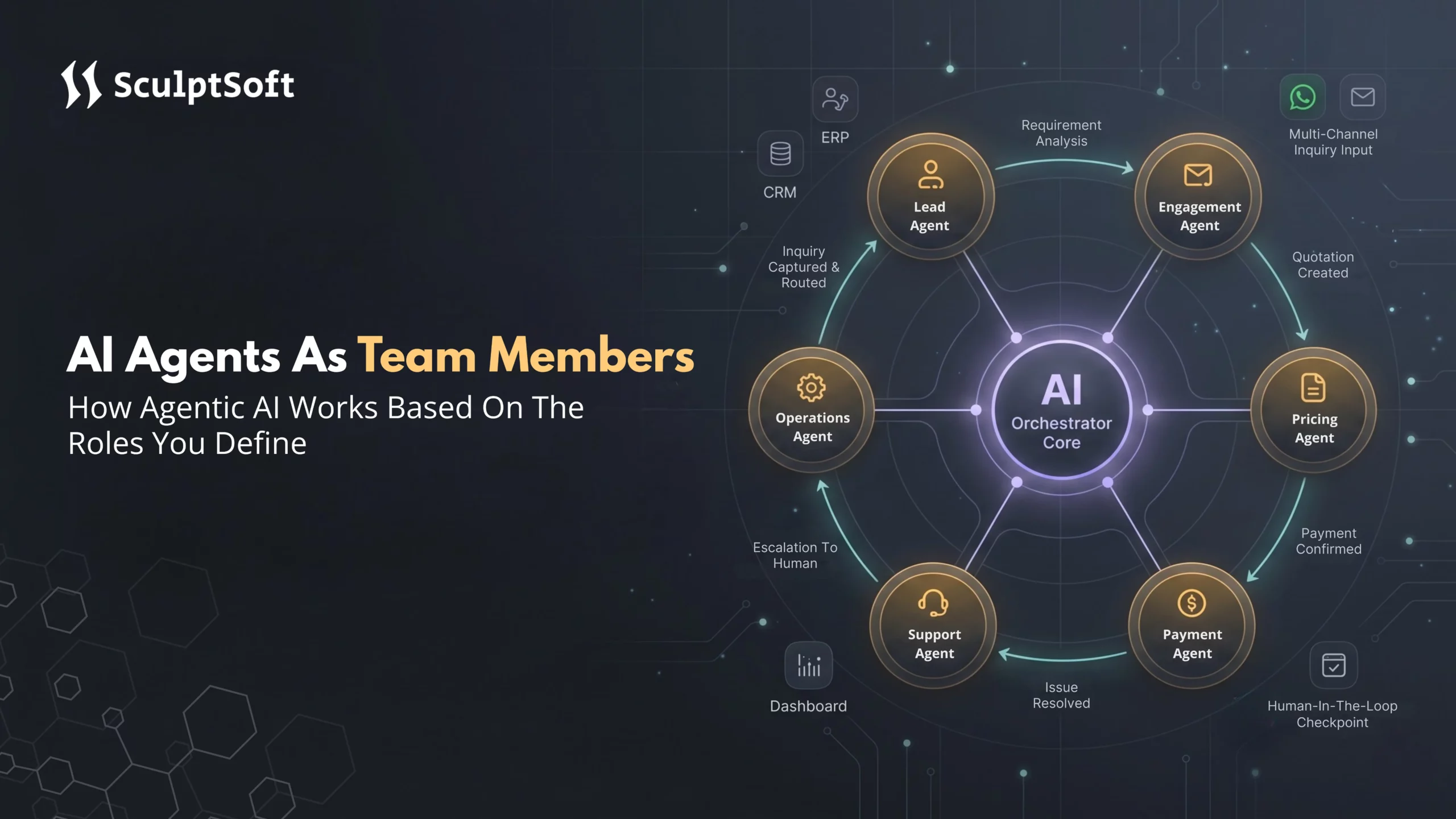
Now imagine a different model. What if AI Agents worked as team members in your business? Not a single tool doing a single job, but a coordinated digital workforce where each AI Agent is assigned a defined role with clear responsibilities and instructions you control. One agent manages inbound requests. Another coordinates workflows across departments. Another handles follow-ups and reminders. Each one operates based on the roles you define, and an orchestrator keeps everything running without waiting for a human to initiate every step.
That is how Agentic AI works. It turns AI from a disconnected tool into a multi-agent AI system where specialized agents collaborate across your business functions, the same way a well-structured team would.
This blog breaks down how Agentic AI works in practice: how AI Agents map to your existing business structure, where the biggest operational gaps exist, how to automate your sales process using a multi-agent AI system, and the measurable outcomes it delivers when you build AI into the way your organization runs.
How Every Business Is Structured and Where AI Agents Fit In
Before you can deploy AI Agents as team members, you need to understand where they fit. And that starts with how your business is already structured.
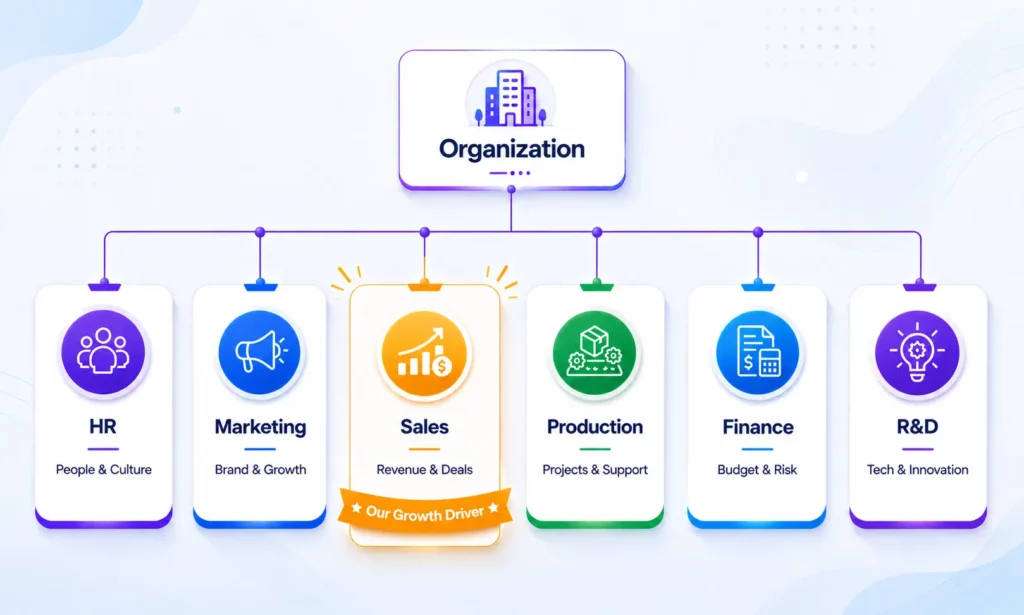
Every organization, regardless of size, industry, or geography, operates through a set of core functions. A 50-person company and a 5,000-person enterprise both rely on the same foundational departments. The scale is different, but the workflow is the same. And within each of these functions, there are dozens of repeatable, high-volume tasks that consume your team’s time every single day.
Here is what that looks like across a typical business:
HR
- Screening resumes, scheduling interviews, and coordinating hiring workflows
- Running employee onboarding, training schedules, and offboarding processes
- Managing payroll, leave tracking, and engagement surveys
Marketing
- Running campaigns and managing lead generation pipelines
- Tracking engagement metrics and nurturing prospects
- Coordinating content production across channels
Sales
- Handling inbound inquiries and qualifying leads
- Sending proposals, generating quotations, and managing follow-ups
- Tracking deal progress from first conversation to closure
Development/Production/Services
- Managing project timelines, task assignments, and delivery milestones across teams
- Running quality checks, testing workflows, and coordinating issue resolution
- Tracking production schedules, service delivery progress, and client deliverables
Finance
- Processing invoices, matching purchase orders, and flagging discrepancies
- Managing payment cycles, reminders, and reconciliation
- Generating compliance and financial reports
Operations
- Coordinating cross-department handoffs and approval chains
- Tracking vendor deliverables, timelines, and SLAs
- Escalating delays and managing exceptions before they snowball
Every one of these tasks is rule-based, time-sensitive, and repeatable. And in most businesses today, every one of them still depends on a person remembering to do it, finding the time to do it, and doing it consistently even when the team is stretched thin.
That is the gap Agentic AI is built to close.
Gartner projects that 40% of enterprise applications will embed task-specific AI Agents by the end of 2026, up from less than 5% in 2025.
Businesses can now assign specialized AI Agents with defined roles and clear instructions to handle the routine, repetitive volume across each of these departments, so your team can focus on the work that actually requires human judgment, creativity, and relationship building. An AI Agent in HR screens resumes and triggers onboarding workflows. An Agent in finance matches invoices and sends payment reminders. An agent in operations tracks status across teams and escalates delays automatically. Each one operates within the role and responsibilities you define, working alongside your human team as part of a multi-agent digital workforce.
When a task requires complex decision-making, sensitive conversations, or exceptions that fall outside the norm, the system hands off to the right person with full context. Your team stays in control. AI Agents handle the volume. Humans handle the judgment.
Your business structure does not change. The way work moves through it does.
Now, to see how this works at a practical level, it helps to zoom into one function where the challenges are most visible and the outcomes are most measurable. For most businesses, that function is Sales. The next section breaks down the traditional sales cycle step by step and shows exactly where the bottlenecks build up.
The Sales Cycle Every Business Runs and Why It Matters
Every business that sells a product or service runs through a sales cycle. Whether you operate in B2B, B2C, retail, manufacturing, or services, the stages of your sales pipeline follow the same pattern. What changes is scale. A single deal typically requires 15 to 20 individual actions before it reaches closure. Multiply that across every active deal your team manages, and you start to see why the sales cycle is the first function most businesses explore when deploying AI Agents as team members with defined roles.
Here is what a typical end-to-end sales cycle looks like:
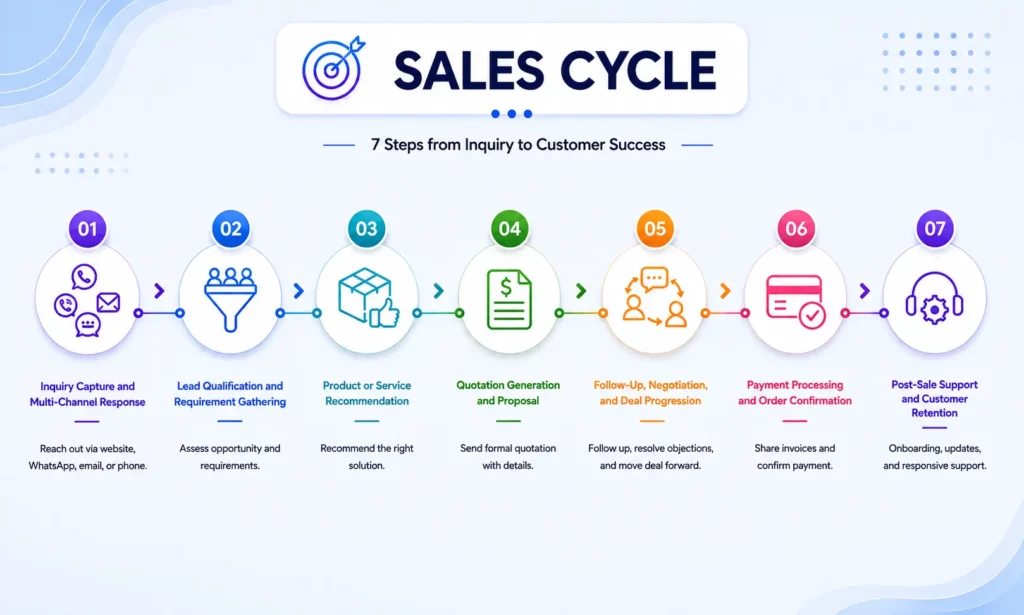
Stage 1: Inquiry Capture and Multi-Channel Response
- Prospects reach out through the website, WhatsApp, social media, email, or phone
- Each inquiry needs to be acknowledged, logged, and routed to the right person
Stage 2: Lead Qualification and Requirement Gathering
- The team assesses whether the inquiry is a real opportunity based on requirements, budget, timeline, and decision-making authority
Stage 3: Product or Service Recommendation
- Based on the prospect’s needs, the team recommends the right solution, often requiring input from another department on pricing, inventory, or specifications
Stage 4: Quotation Generation and Proposal
- A formal quotation is generated with pricing, terms, scope, and delivery details
Stage 5: Follow-Up, Negotiation, and Deal Progression
- The team follows up to address objections, answer questions, and move the deal forward through the pipeline
Stage 6: Payment Processing and Order Confirmation
- Once the deal is agreed, invoices go out, payment links are shared, and proof of payment is tracked
Stage 7: Post-Sale Support and Customer Retention
- After closure, the customer expects onboarding assistance, delivery updates, and responsive service
That is seven stages, multiple departments involved, and dozens of manual touchpoints across every deal in your sales pipeline. This is not a people problem. It is a process and scale problem that compounds with every new inquiry your business receives.
The question is: what happens when this entire sales process depends on manual effort and demand outgrows your team’s capacity?
Key Challenges When Your Sales Cycle Depends Entirely on People
Every business runs a sales cycle. But not every business realizes how much revenue it loses when that cycle depends entirely on manual effort.
The average B2B lead response time in 2026 is 47 hours. Harvard Business Review research shows that responding within 5 minutes makes a lead 21 times more likely to qualify compared to waiting just 30 minutes.
That single stat explains why most manual sales pipelines underperform. But slow response time is only one part of the problem. When your sales process runs without AI Agents or any form of intelligent automation, the challenges compound at every stage.
Here are the seven most common challenges businesses face when the entire sales cycle depends on people:
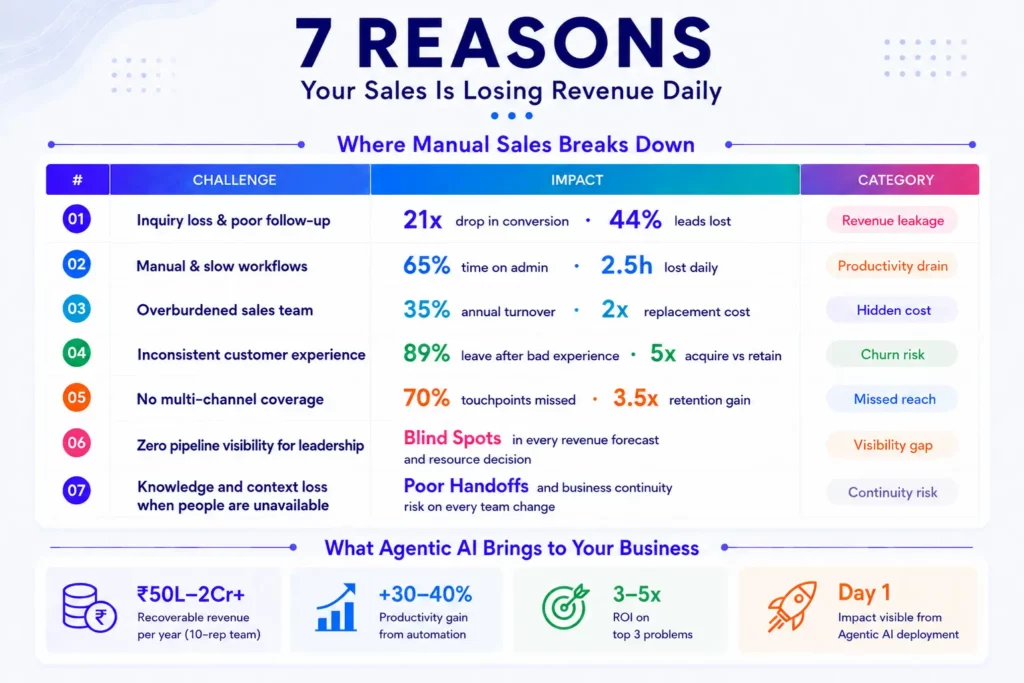
1. Inquiry Loss and Poor Follow-Up
- Leads come in from the website, WhatsApp, social media, email, and phone, often outside business hours
- Over 40% of high-intent inquiries arrive during evenings and weekends when no one is available to respond
- Without a system that captures and responds instantly, these leads go cold or move to a competitor who replied first
- The revenue lost here is invisible because most businesses never even know these leads existed
2. Manual and Slow Workflows
- Every step from lead qualification to quotation generation involves manual data entry, internal coordination, and back-and-forth approvals
- A task that an AI Agent with defined instructions could complete in minutes takes hours or days when it depends on human availability
- The longer your sales pipeline takes to move a deal forward, the lower your conversion rate drops
3. Overburdened Sales Teams
- Sales representatives spend a significant portion of their day on administrative work: logging data, chasing internal teams for information, updating CRMs, and sending routine follow-ups
- When representatives manage 30+ active deals, they cannot give consistent attention to every prospect
- High-value activities like relationship building, complex negotiations, and strategic conversations get deprioritized because the team is buried in repetitive process work
4. Inconsistent Customer Experience
- The quality of response depends entirely on which representative is available, how busy they are, and whether they have the right context
- One prospect gets a detailed reply within an hour. Another waits two days for a generic response
- Inconsistency at any stage of the sales cycle directly impacts customer trust, brand perception, and deal closure rates
5. No Multi-Channel Coverage
- Most businesses receive inquiries across five or more channels but lack the infrastructure to manage all of them in real time
- Leads from social media or messaging platforms often get lower priority than email or phone inquiries
- Without a unified multi-channel system, customer data gets fragmented across tools, conversations lose context, and the same prospect sometimes gets contacted by two different representatives
6. Zero Pipeline Visibility for Leadership
- Business leaders and sales managers rarely have a real-time view of where deals stand across the pipeline
- Data lives in individual inboxes, personal spreadsheets, and CRM entries that are rarely updated on time
- Leadership ends up making revenue forecasts and resource decisions based on assumptions instead of actual pipeline data
- This lack of visibility is one of the biggest reasons leads slip through without anyone noticing until it is too late
7. Knowledge and Context Loss When People Are Unavailable
- When a sales representatives goes on leave, switches roles, or exits the company, their deal context, conversation history, and relationship knowledge leaves with them
- The next person picking up the deal starts from scratch, and the customer is asked to repeat everything
- This creates a poor experience for the customer and a real business continuity risk for the organization
- There is no institutional memory when the entire sales process lives in people’s heads and personal inboxes
These are not occasional issues. These are structural problems that exist in every business running a manual sales process at scale. And they get worse, not better, as inquiry volume grows.
The real question is: what would your sales cycle look like if AI Agents with defined roles handled the repetitive, time-sensitive, and high-volume parts of this pipeline while your team focused on the conversations and decisions that genuinely require human inputs?
How an AI Sales Automation Platform Transforms Your Entire Sales Pipeline
Most businesses using AI in sales today are using it for isolated tasks. Understanding how AI sales automation works starts with recognizing this gap. True sales process automation requires a coordinated system, not disconnected tools.
A chatbot answers FAQs. A CRM plugin scores leads. An email tool sends sequences. None of them talk to each other, and none of them automate the sales process end to end.
A multi-agent AI sales automation platform works differently. It deploys a coordinated team of AI Agents for sales that work as digital team members within your pipeline. Each agent is assigned a defined role, follows the instructions you configure, and works together with other agents through a central orchestrator. These AI Agents as team members operate exactly based on the roles and responsibilities you define for them.
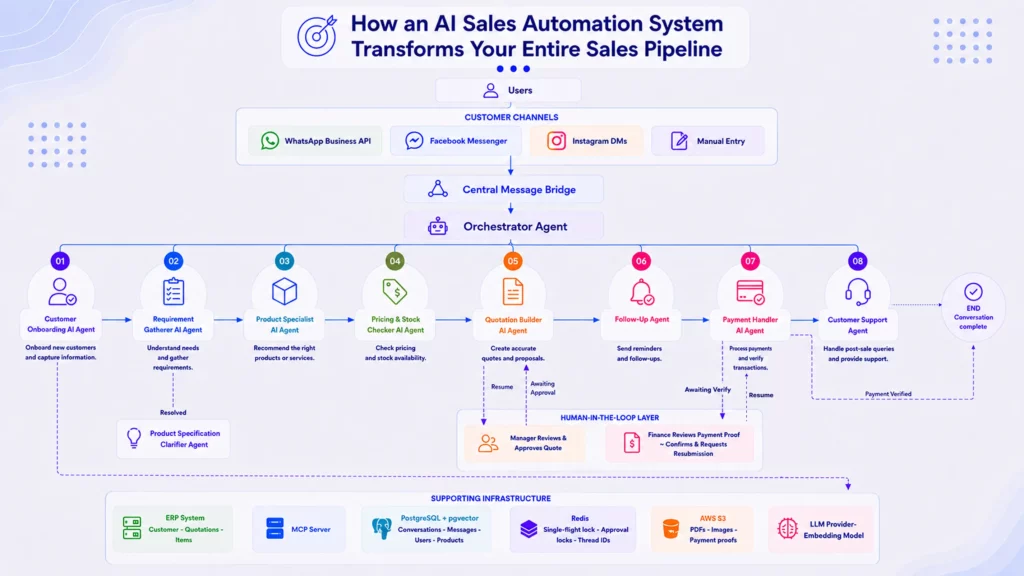
How it works: Customer sends inquiry → Orchestrator routes it → Specialized AI Agents handle each stage from qualification to payment → Human team steps in only when judgment is needed → Deal closes faster with full visibility.
1. Multi-Channel Inquiry Capture
The AI sales system layer connects to WhatsApp, Facebook Messenger, Instagram DMs, website chat, and email. Every inquiry is captured instantly and routed into the AI sales pipeline through a central message bridge. No lead is lost. No channel is unmonitored. Multichannel sales automation runs 24/7, 365 days.
2. Orchestrator Agent
The orchestrator receives every message, understands intent, and routes it to the right agent. A new inquiry goes to onboarding. Returning customers go to support. Pending quote triggers follow-up. This is what real sales pipeline management looks like: sales workflow automation running without anyone manually deciding what goes where.
3. Specialized AI Agents with Defined Roles
This is where AI sales automation happens at scale. Each agent follows the instructions you set and hands off to the next when its task is complete. You control what each agent does, how it responds, and when it escalates.
| AI Agent | Role | What It Automates |
|---|---|---|
| Customer Onboarding | First point of contact | Greets, captures requirements, logs the inquiry across any channel |
| Requirement Gatherer | Detailed need assessment | Collects specifications, budget, timeline through conversational questioning |
| Product Specialist | Intelligent recommendation | Matches needs to products using real-time catalog, pricing, and inventory data |
| Pricing and Stock Checker | Availability validation | Confirms pricing, stock levels, and delivery timelines before quotation |
| Quotation Builder | Instant quote generation | Creates customized quotations in minutes, routes for approval automatically |
| Payment Handler | End-to-end payment processing | Sends payment links, tracks status in real time, confirms receipt, triggers order processing |
| Customer Support | Post-sale engagement | Handles delivery updates, service queries, and retention across all channels |
AI Agent
Customer Onboarding
Role
First point of contact
What It Automates
Greets, captures requirements, logs the inquiry across any channel
AI Agent
Requirement Gatherer
Role
Detailed need assessment
What It Automates
Collects specifications, budget, timeline through conversational questioning
AI Agent
Product Specialist
Role
Intelligent recommendation
What It Automates
Matches needs to products using real-time catalog, pricing, and inventory data
AI Agent
Pricing and Stock Checker
Role
Availability validation
What It Automates
Confirms pricing, stock levels, and delivery timelines before quotation
AI Agent
Quotation Builder
Role
Instant quote generation
What It Automates
Creates customized quotations in minutes, routes for approval automatically
AI Agent
Payment Handler
Role
End-to-end payment processing
What It Automates
Sends payment links, tracks status in real time, confirms receipt, triggers order processing
AI Agent
Customer Support
Role
Post-sale engagement
What It Automates
Handles delivery updates, service queries, and retention across all channels
Each of these agents operates as a dedicated team member in your sales pipeline. Together, they deliver complete sales process automation from first inquiry to payment confirmation, covering automated lead management, sales order processing automation, and sales follow-up automation in one unified system.
The result: your business can close deals faster, handle more volume, and scale without adding headcount to repetitive tasks.
4. Configurable Human-in-the-Loop at Any Stage of Your Sales Pipeline
Not every conversation in your sales pipeline should be handled by AI Agents alone. And not every business needs human involvement at the same stages. That is why a well-designed AI sales automation platform comes with fully configurable human gates that you control.
You decide where and when humans step in across the sales cycle:
- A manager needs to review and approve high-value quotations before they reach the customer? Add a human gate at the quotation stage.
- Your finance team needs to verify payment proofs before order confirmation? Add a human gate at the payment processing stage.
- A senior sales representative needs to handle enterprise-level negotiations personally? Add a human gate at the deal progression stage.
Every checkpoint in the system is configurable based on how your business operates. You can place human involvement at any stage of the sales pipeline, whether it is quotation approval, payment verification, or complex deal negotiations. Your team stays involved wherever their expertise matters most, and the system adapts as your business requirements evolve.
When a human gate is triggered, the multi-agent AI system hands off to your team with full conversation context, customer history, and deal data. No information loss. No asking the customer to repeat themselves. Your team steps in fully informed and picks up exactly where the AI Agent left off.
This configurable human-in-the-loop design is what makes AI Agents as team members work for any business, in any industry, at any scale. The AI Agents handle the volume, speed, and consistency across your automated sales workflow. Your people step in exactly where and when you decide they should. Together, they operate as one team, on your terms.
Build Your Own AI Agent Team
This architecture is not a fixed product. Using an AI workflow builder platform, non-technical business users can design, configure, and deploy AI Agents through a visual drag-and-drop interface. You define the roles. You set the instructions. You add or modify agents without writing code. The same multi-agent pattern that automates your sales pipeline can extend to operations, HR, finance, or any function with repeatable processes.
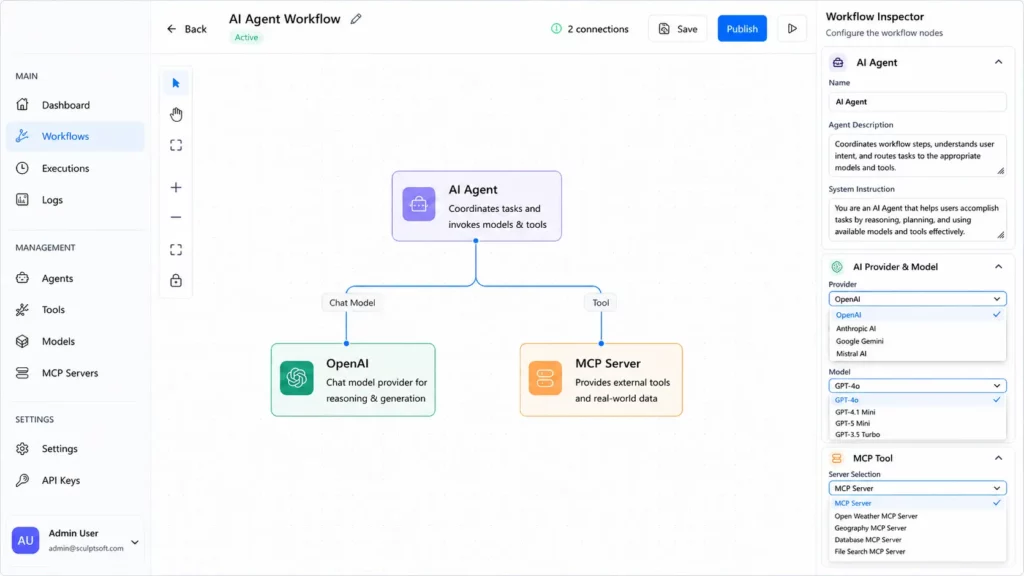
This is what AI powered sales looks like in production. Not one chatbot, but a full team of AI Agents working as team members across your entire sales pipeline, each with defined roles, operating on the instructions you set. The platform helps your business automate sales processes, close deals faster, and free your human team to focus on what they do best.
Measurable Outcomes When AI Agents Run Your Sales Pipeline
Every business running a manual sales process faces the same set of problems. The scale may differ, but the pattern is always the same.
- How many leads did your sales team lose last month because no one responded to inquiries in time?
- How many quotations took days instead of minutes because the sales pipeline had no automation?
- How many follow-ups never happened because your representatives were managing 30+ active deals manually?
- How many deals went silent because there was no AI sales assistant to track and re-engage prospects automatically?
- How much pipeline data is buried in personal inboxes and spreadsheets instead of a real-time sales dashboard?
These are not one-off situations. These are everyday revenue leaks that exist in every business where the sales cycle depends entirely on people and manual effort.
Now let us take an example. Consider a business handling around 250 sales inquiries per month across multiple channels with a team of sales representatives managing the entire pipeline manually. Here is what the outcomes look like when that same business deploys AI Agents as team members with defined roles across every stage of the sales pipeline.
Sales Pipeline Performance: Traditional vs AI Agents as Team Members
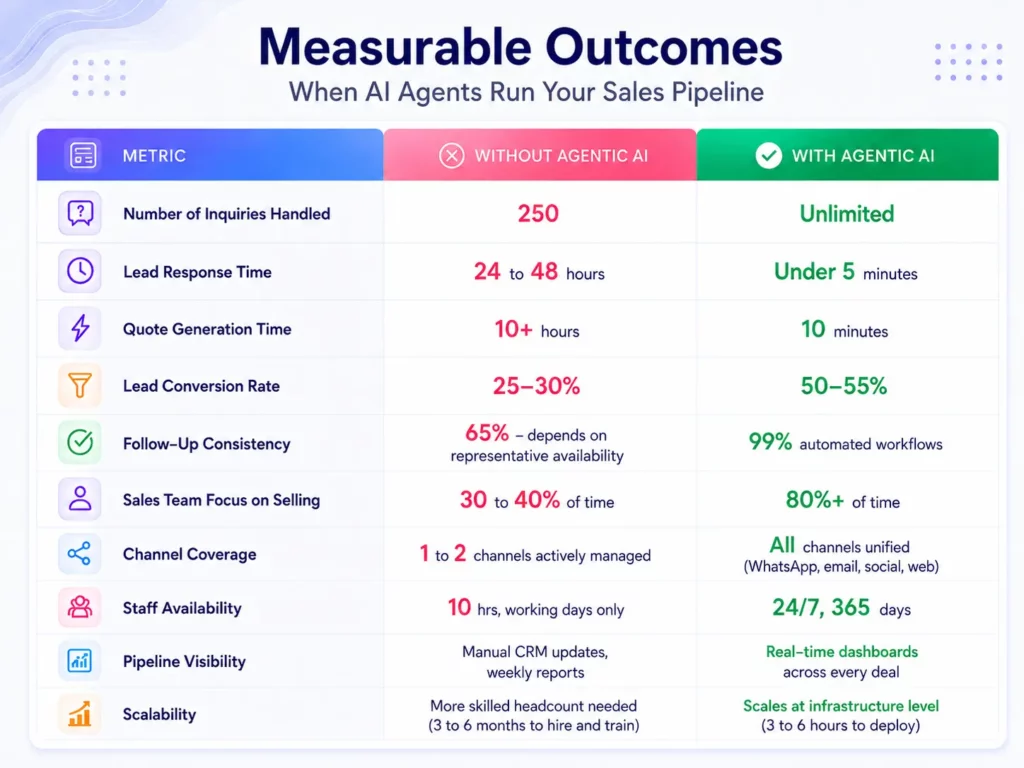
The outcomes of deploying AI Agents for sales across your pipeline are proven. Whether you want to automate your entire sales pipeline or start with one stage, the results scale with your implementation.
What Every Business Should Consider Before Building an AI Agent Team
Deploying AI Agents as team members using agentic AI is not just a technology decision. Knowing how to build an AI Agent team that actually delivers requires evaluating these key factors. It is an operational decision that impacts how your teams work, how data flows across departments, and how your business scales. Before you build a multi-agent AI system, here are the key factors every business leader should evaluate.
1. Custom-Built vs Off-the-Shelf AI Agents
| Factor | Off-the-Shelf | Custom-Built |
|---|---|---|
| Setup Speed | Fast (plug and play) | Longer initial build |
| Customization | Limited to vendor features | Fully tailored to your workflows |
| Scalability | Depends on vendor roadmap | Scales with your business needs |
| Long-Term Control | Vendor controls updates and pricing | You own the system entirely |
For standard use cases, off-the-shelf works. For businesses that need AI Agents with defined roles across sales, operations, or custom workflows, a custom-built AI solution gives you full ownership and flexibility.
2. Vendor Lock-In and LLM Flexibility
Getting locked into a single AI model or vendor is one of the biggest risks in AI Agent deployment. If your provider changes pricing, performance, or policies, your entire operation is affected. Look for an LLM-agnostic architecture that lets you switch or combine models without rebuilding the system.
3. Human-in-the-Loop Design
AI Agents should handle volume, speed, and routine execution. But complex negotiations, sensitive escalations, and high-value approvals must route to your human team with full context. Look for configurable escalation rules, full conversation handoff, and clear thresholds for when AI acts independently vs when it involves a person.
4. Data Privacy, Security, and Compliance
AI Agents interact with customer data, transaction records, and internal business information. Before deployment, evaluate where data is stored and processed, whether the system supports role-based access control and audit logs, and whether it can be deployed in a private or self-hosted environment if compliance requires it.
5. Integration with Existing Systems
Your AI Agents need to connect seamlessly to CRM, ERP, communication channels (WhatsApp, email, social media), payment gateways, and internal databases. A multi-agent AI sales automation system that cannot plug into your existing infrastructure creates more work, not less.
6. Non-Technical Team Access
If every change to an AI Agent’s behavior requires a developer, the system becomes a bottleneck. Look for a visual drag-and-drop AI workflow builder where business users like sales managers, operations leads, and anyone can adjust agent roles, instructions, and escalation rules without writing code.
7. Monitoring and Continuous Improvement
Deploying AI Agents as digital team members is not a one-time project. It is an ongoing operation. You need real-time visibility into agent response times, pipeline metrics, error rates, escalation frequency, and ROI per agent to continuously optimize how your AI workforce performs.
Bottom line: The businesses that succeed with AI Agents as team members are not the ones that deploy the fastest. They are the ones that build with the right architecture, the right controls, and the right balance between AI autonomy and human judgment.
How SculptSoft Builds Custom AI Agent Teams for Enterprises
Every business has its own structure, its own workflows, and its own processes that need to move faster, run consistently, and scale. A generic AI tool cannot solve that. A custom-built AI Agent team can.
As an AWS Select Tier Partner specializing in custom AI development, Agentic AI solutions, and multi-agent system architecture, we design, build, and deploy AI Agents that work as dedicated team members within your business. Across sales, operations, HR, finance, customer support, or any function with repeatable, high-volume workflows. You define the roles. You set the instructions. Your agents execute.
What We Build
We build custom multi-agent AI systems tailored to your specific business processes. Every AI Agent is designed around how your business actually operates, integrated with your existing systems (CRM, ERP, communication channels, databases), and built with human-in-the-loop from day one.
Our two proven solutions:
- Agentic AI Sales & Order Automation Platform is a coordinated team of AI Agents that automates the entire sales cycle from multichannel inquiry capture to payment confirmation, with seamless handoff to human teams for high-value and complex scenarios.
- AI Workflow Builder Platform is a no-code/low-code platform we built that lets businesses design, configure, and deploy AI Agents for any department through a visual drag-and-drop interface. Define roles, set instructions, connect tools, and manage agent behavior without writing code. Built with an LLM-agnostic core, no vendor lock-in, and live monitoring for real-time visibility.
Both solutions follow the same principle: AI Agents as team members with defined roles and responsibilities that your team controls. Whether you need a fully custom-built system or a platform where your own team builds and manages agents independently, we deliver both with full ownership, enterprise-grade security, and zero vendor dependency.
Want to explore how AI Agents with defined roles can work across your business?
Contact us today at info@sculptsoft.com
Final Thoughts
AI Agents as team members are not a future concept. They are already transforming how businesses run their sales pipelines, manage operations, handle customer support, and coordinate workflows across departments.
Key Takeaways:
- AI Agents are not just basic automation. They handle repeatable, dynamic, and complex tasks intelligently within the roles you define
- The sales cycle is the most common starting point for deploying AI Agents with defined roles
- A multi-agent AI system automates the entire pipeline while keeping humans in the loop for judgment and decisions
- Measurable outcomes include faster response times, higher conversions, 24/7 availability, and real-time pipeline visibility
- Before building, evaluate custom vs off-the-shelf, vendor lock-in, data privacy, integrations, and non-technical access
At SculptSoft, we build custom AI Agent teams for enterprises. From AI sales automation platforms to AI workflow builder solutions, we help businesses design, deploy, and scale AI Agents that work based on the roles and instructions you define. No vendor lock-in. Full ownership. Human-in-the-loop by design.
Are you ready to build your AI Agent team?
Frequently Asked Questions
What does it mean when AI Agents work as team members?
Each AI Agent is assigned a specific role with defined instructions, just like a human team member. One handles inquiries, another qualifies leads, another generates quotations. They work together through an orchestrator and escalate to humans when the task requires judgment.
How do AI Agents automate the sales pipeline?
Specialized AI Agents are placed at every stage of the sales cycle, from inquiry capture to payment confirmation. Each agent handles its stage automatically across multiple channels, 24/7, while a central orchestrator coordinates the flow between agents and human team members.
What is the difference between a chatbot and an Agentic AI Agent?
Do AI Agents replace human employees?
No. AI Agents handle repetitive, high-volume, and time-sensitive tasks. Your human team focuses on complex decisions, relationship building, and high-value conversations. Human-in-the-loop design ensures people stay in control of what matters most.
Can non-technical teams manage AI Agents?
Yes. With an AI workflow builder platform, business users can configure agent roles, instructions, and escalation rules through a visual drag-and-drop interface without writing code.
What business functions can AI Agents be deployed in?
Sales, customer support, operations, HR, and finance are the most common starting points. Any function with repeatable, high-volume workflows can benefit from AI Agents with defined roles.